- English
- French
- German
- Portuguese
- Spanish
- Russian
- Japanese
- Korean
- Arabic
- Greek
- German
- Turkish
- Italian
- Danish
- Romanian
- Indonesian
- Czech
- Afrikaans
- Swedish
- Polish
- Basque
- Catalan
- Esperanto
- Hindi
- Lao
- Albanian
- Amharic
- Armenian
- Azerbaijani
- Belarusian
- Bengali
- Bosnian
- Bulgarian
- Cebuano
- Chichewa
- Corsican
- Croatian
- Dutch
- Estonian
- Filipino
- Finnish
- Frisian
- Galician
- Georgian
- Gujarati
- Haitian
- Hausa
- Hawaiian
- Hebrew
- Hmong
- Hungarian
- Icelandic
- Igbo
- Javanese
- Kannada
- Kazakh
- Khmer
- Kurdish
- Kyrgyz
- Latin
- Latvian
- Lithuanian
- Luxembou..
- Macedonian
- Malagasy
- Malay
- Malayalam
- Maltese
- Maori
- Marathi
- Mongolian
- Burmese
- Nepali
- Norwegian
- Pashto
- Persian
- Punjabi
- Serbian
- Sesotho
- Sinhala
- Slovak
- Slovenian
- Somali
- Samoan
- Scots Gaelic
- Shona
- Sindhi
- Sundanese
- Swahili
- Tajik
- Tamil
- Telugu
- Thai
- Ukrainian
- Urdu
- Uzbek
- Vietnamese
- Welsh
- Xhosa
- Yiddish
- Yoruba
- Zulu
What Is a 16-Bit PXI Analog Acquisition Board Used For?
A 16-bit PXI analog acquisition board is a high-precision data acquisition module designed to capture, digitize, and process analog signals within PXI (PCI eXtensions for Instrumentation) modular test systems. These boards excel at converting real-world analog signals into digital format with exceptional accuracy, providing 65,536 discrete measurement levels that enable precise signal analysis across industrial automation, aerospace testing, semiconductor validation, and research applications where measurement fidelity remains paramount.
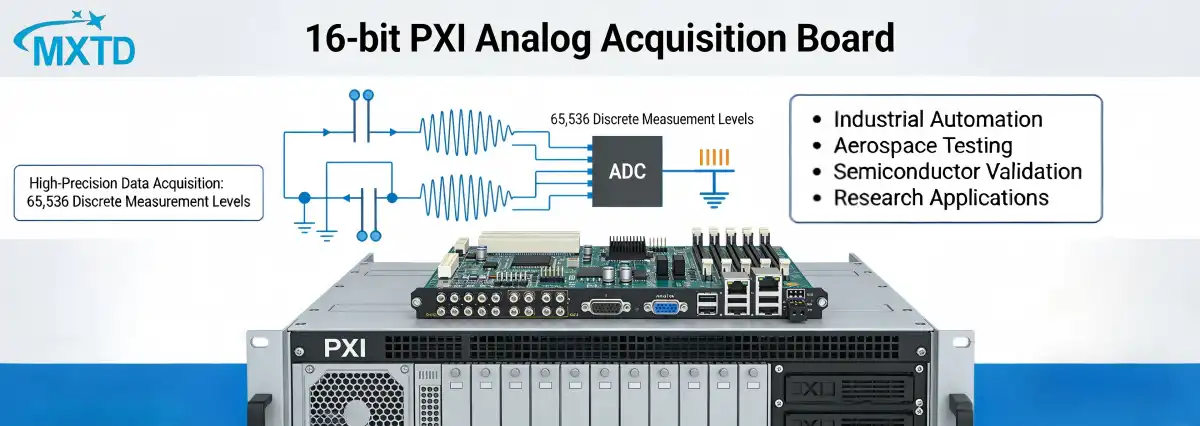
Understanding the 16-Bit PXI Analog Acquisition Board
The 16-bit PXI analog acquisition board is a high-tech way to measure things that was made for harsh industrial settings where accuracy is essential. These modules work perfectly with PXI chassis systems because they take advantage of the standard's benefits, such as synchronized time, flexible scalability, and standard form factors that make it easier to set up complex test scenarios.
Core Functionalities and Architecture
PXI analog acquisition boards work by sampling and receiving analog signals at set rates and converting them through high-resolution analog-to-digital converters (ADCs) that keep the integrity of the signals while they are being digitized. When compared to lower-resolution options, the 16-bit resolution provides much better granularity. This lets engineers find tiny changes in signals that could mean important system actions or possible problems.
PXI systems are flexible, which means that multiple acquisition boards can work together in the same frame at the same time. This makes for powerful multi-channel measurement tools. This design is very useful for situations where multiple sensors, transducers, or test points need to send data at the same time across complicated systems that are being evaluated.
Why 16-Bit Resolution Matters
There are more changes between 12-bit, 14-bit, and 16-bit precision than just numbers. Each extra bit doubles the granularity of the measurement. For example, a 16-bit ADC provides four times the quantization levels of a 14-bit system, enabling finer signal resolution. This higher resolution directly leads to more accurate measurements, less quantization noise, and the ability to pick up on small changes in the data that might not be picked up by systems with lower resolution.
System builders and procurement managers know that investing in 16-bit resolution often saves money over the lifetime of the system. This is especially true when measurements need to be very accurate or when future applications may need more sensitivity.
Key Advantages and Specifications of 16-Bit PXI Analog Acquisition Boards
Modern 16-bit PXI analog acquisition board solutions offer big technical and practical advantages that directly meet the tough needs of test engineers and system designers who work in settings where precise measurements are needed.
Technical Superiority Over Lower-Resolution Alternatives
The higher bit depth of 16-bit acquisition systems makes the signal-to-noise ratio (SNR) measured better; they can usually reach 96 dB possible SNR compared to 84 dB for 14-bit systems. This improvement is very important when measuring low-level data in busy industrial settings or when the dynamic range needs to be several orders of magnitude wider.
Modern 16-bit boards have advanced signal conditioning features like configurable gain amplifiers, anti-aliasing filters, and input safety circuits that keep the signal's integrity while working with a range of inputs. Because of these features, you don't need as much external signal processing equipment. This makes the system design simpler and the measurements more accurate overall.
Critical Performance Specifications
Measurement quality and system performance are directly impacted by a number of important parameters when choosing a 16-bit PXI analog acquisition board. Sampling rates for each channel usually run from 100 kS/s to several MS/s. Higher rates make it possible to record faster, brief events or do a wider frequency content analysis.
How well the board works with real-world signal conditions is based on its input impedance, common-mode rejection rates, and offset stability specs. Professional-level boards have great uniformity across their entire input range and strong security against overvoltage situations that could harm sensitive measurement circuits.
Procurement and Support Considerations
Leading makers offer full warranties that usually last between one and three years, as well as quick expert support that can answer both application questions before the sale and integration problems after the product has been delivered. Standard goods usually have delivery times between days and weeks. Customized solutions, on the other hand, may need longer lead times depending on their unique needs.
An awful lot of companies sell review tools that let engineers try out boards in real-world situations before they decide to buy them. This method lowers the risk of procurement while making sure that the solutions chosen meet certain performance standards in real-world working circumstances.
Applications of 16-Bit PXI Analog Acquisition Boards in Industry
The versatility of 16-bit PXI analog acquisition board technology is very flexible, so it can be used in many different manufacturing fields where accurate measurements are needed for things like making sure products are safe and working at their best.
Aerospace and Defense Applications
When checking the reliability and accuracy of flight control systems, engine performance, and structural stability in a variety of working situations, aerospace testing environments are very strict. These boards are great at getting sensor data from accelerometers, strain gauges, temperature sensors, and pressure detectors, and they can do this well in the lab as well as in the field.
High-resolution skills are used in defense to gather signal intelligence, calibrate radar systems, and test electronic warfare, all of which are important for mission success because of how well the signals work. Professional PXI systems are built to last and work reliably, so they can be used in tough places like mobile test labs and the field.
Industrial Automation and Manufacturing
Acquiring precise data is used in manufacturing settings for quality control, process tracking, and predictive maintenance programs that cut down on unnecessary downtime. 16-bit PXI analog acquisition board devices record vibration patterns, temperature profiles, and electrical traits that show how healthy the equipment is and how consistent the quality of the products is.
These boards are used by automated test equipment (ATE) interfaces to make sure that parts work, to test finished products, and to collect statistical process control data. PXI systems have built-in synchronization features that let you run complicated test routines that check multiple product traits at the same time. This increases test throughput while keeping measurement accuracy high.
Research and Development Environments
High-resolution data collection is important for basic research, testing new products, and academic studies that need accurate measurements. This is something that research institutions and business R&D centers rely on. Custom sensor interfaces, long-term tracking programs, and multi-physics tests that are hard to do with standard instruments are common in these situations.
Through case studies from car research facilities, 16-bit capture systems make it possible to study in great detail how engines burn fuel, how transmissions work, and how vehicles move in a controlled laboratory setting. Better data quality as a result has led to better product ideas and shorter development cycles.
How to Choose the Right 16-Bit PXI Analog Acquisition Board for Your Needs?
Selecting the optimal 16-bit PXI analog acquisition board requires careful consideration of technical specs, seller skills, and long-term support needs that are in line with your application's needs and your company's purchasing policies.
Essential Technical Evaluation Criteria
Board choices are greatly affected by the number of channels needed. There are single-channel high-performance units as well as 64-channel or higher-density solutions. Higher channel counts take up less room in the frame, but the performance or sampling rate of each channel may suffer.
Because the input range is flexible, a single board can work with different types of sensors without needing extra signal shaping. Boards with input values that can be programmed in software, ranging from millivolts to tens of volts, give you the most options for applications while keeping the system simple and low-cost.
Vendor Comparison and Selection Factors
National Instruments is still the clear winner in PXI technology. They have a wide range of products, a lot of software support, and service networks all over the world. Competitive options are available from Keysight Technologies, which has strong measurement skills and strong hardware designs. MXTD offers solutions that are both affordable and meet industry standards. They also offer quick customer service and the ability to make changes to the solutions as needed.
The total cost of ownership should be looked at by procurement teams. This includes the original gear costs, software licensing fees, training needs, and ongoing support costs. Some sellers offer good bulk discounts for large-scale deployments, and they also offer choices for longer warranties that lower the risks of long-term ownership.
Integration and Support Considerations
For 16-bit PXI analog acquisition boards to work well, they need to have enough technical help during both the initial integration and ongoing operation stages. Vendors who offer detailed instructions, examples of how to use their products, and quick expert support can help shorten project timelines and lower the risks of merging.
The general success of a system depends on how well its software works with current development environments, measurement software packages, and data analysis tools. A lot of new boards come with drivers for common computer languages like LabVIEW, Python, C/C++, and MATLAB. This makes it possible to connect them to a wide range of software systems.
Comparing Leading 16-Bit PXI Analog Acquisition Board Solutions
The current market offers numerous 16-bit PXI analog acquisition board choices on the market right now, all from well-known hardware companies. Each one offers a different set of benefits that can help with a variety of applications and budgets.
Performance and Feature Comparison
Tier-one suppliers usually offer the highest sampling rates, the lowest noise floors, and the fullest software support packages for their high-end products. These goods are very expensive, but they have been shown to work reliably in mission-critical situations where performance cannot be compromised.
Mid-tier options offer great performance at lower prices by focusing on core measurement features and getting rid of less-used ones. For normal industrial applications that need solid 16-bit performance without any special requirements, these boards are often the best value for money.
Competitive specs and good prices are what MXTD devices offer, and they are also compatible with standard software interfaces in the business. Their solutions are great options for procurement situations that need to be cost-effective without losing important performance qualities.
Return on Investment Analysis
Buying higher-resolution capture systems usually pays off because they improve the quality of measurements, cut down on test times, and make sure that the quality of the products is always the same. Finding smaller changes in signals can help keep products from needing to be recalled or failing in the field, which can cost a lot more than the original investment in the instruments.
Long-term scalability factors support modular PXI approaches over standard box instruments, especially for uses that might need to add more space or improve their specifications. Standardized form factors and interface standards in PXI systems protect the worth of investments and allow systems to change in the future.
Vendor Support and Service Capabilities
Professional instrumentation suppliers are different from basic suppliers because they offer full after-sales help. Leading providers keep up global service networks, offer quick repair programs for important applications, and offer application engineering help for tricky integration issues.
Uptime and running costs are directly affected by warranty terms, fix turnaround times, and the availability of calibration services. For mission-critical projects, vendors that offer longer warranty choices, advance replacement programs, and on-site service skills are more valuable.
Conclusion
The 16-bit PXI analog acquisition board is an important piece of measurement equipment for businesses that need to get accurate data in automated manufacturing, aircraft testing, research settings, and chip validation settings. These modules offer high measurement accuracy, a variety of configuration choices, and scalable architectures that can be used for a wide range of applications while still keeping long-term investment value. Modern options from well-known companies offer dependable performance, full software support, and quick customer service that lower interface risks and raise measurement capabilities.
FAQ
What are the main differences between 12-bit and 16-bit acquisition boards?
16-bit PXI analog acquisition board systems have 16 times more precision than 12-bit systems, with 65,536 discrete measurement levels instead of 4,096 levels. This higher sharpness lets you see smaller changes in the data, makes measurements more accurate, and gives you better dynamic range performance in tough situations.
How does sampling rate affect measurement accuracy?
Higher sampling rates let you record faster signal changes and a wider range of frequencies, but too much sampling can make noise worse and require more space for data storage. Nyquist says that the best sampling rate should be at least twice the highest frequency component of interest, plus some extra room for anti-aliasing filter considerations.
What factors should be considered when sourcing reliable acquisition boards?
Purchasing teams should look at the name of the seller, the length of the guarantee, how quickly technical support responds, how well the product works with other software, and how long the product will be available. Suppliers who give full paperwork, models of how to use their products, and calibration services add value and lower the risks of merging and the costs of running the business.
Partner with MXTD for Advanced 16-Bit PXI Analog Acquisition Solutions
MXTD delivers industry-leading 16-bit PXI analog acquisition board solutions that combine proven reliability with competitive pricing for demanding test and measurement applications. Our wide range of products includes both standard modules and unique designs that are made to fit the needs of a particular application while still working with standard software interfaces. As a trusted 16-bit PXI analog acquisition board supplier, we provide comprehensive technical support, rapid response times, and flexible delivery options, including express shipping for urgent projects. Contact our engineering team at manager03@mxtdinfo.com for detailed product specifications, application consultations, and customized quotations that address your precision measurement requirements.
References
1. Institute of Electrical and Electronics Engineers. "IEEE Standard for PCI eXtensions for Instrumentation (PXI) Bus Specification." IEEE Std 1155-2014, 2014.
2. National Institute of Standards and Technology. "Guidelines for High-Resolution Data Acquisition Systems in Industrial Environments." NIST Technical Publication 1800-23, 2019.
3. International Organization for Standardization. "Test and Measurement Equipment - Specifications for Analog-to-Digital Converters." ISO/IEC 17025:2017.
4. Society of Automotive Engineers. "Recommended Practices for Data Acquisition in Automotive Testing." SAE International Standard J2534-1, 2018.
5. American National Standards Institute. "Performance Standards for Modular Instrumentation Systems." ANSI/ISA-67.04.01-2018.
6. International Electrotechnical Commission. "Measurement Equipment - Requirements for Analog Signal Processing." IEC 61298-2:2016.
Our customers’ satisfaction speaks for our quality — contact us to experience the same reliable service.