- English
- French
- German
- Portuguese
- Spanish
- Russian
- Japanese
- Korean
- Arabic
- Greek
- German
- Turkish
- Italian
- Danish
- Romanian
- Indonesian
- Czech
- Afrikaans
- Swedish
- Polish
- Basque
- Catalan
- Esperanto
- Hindi
- Lao
- Albanian
- Amharic
- Armenian
- Azerbaijani
- Belarusian
- Bengali
- Bosnian
- Bulgarian
- Cebuano
- Chichewa
- Corsican
- Croatian
- Dutch
- Estonian
- Filipino
- Finnish
- Frisian
- Galician
- Georgian
- Gujarati
- Haitian
- Hausa
- Hawaiian
- Hebrew
- Hmong
- Hungarian
- Icelandic
- Igbo
- Javanese
- Kannada
- Kazakh
- Khmer
- Kurdish
- Kyrgyz
- Latin
- Latvian
- Lithuanian
- Luxembou..
- Macedonian
- Malagasy
- Malay
- Malayalam
- Maltese
- Maori
- Marathi
- Mongolian
- Burmese
- Nepali
- Norwegian
- Pashto
- Persian
- Punjabi
- Serbian
- Sesotho
- Sinhala
- Slovak
- Slovenian
- Somali
- Samoan
- Scots Gaelic
- Shona
- Sindhi
- Sundanese
- Swahili
- Tajik
- Tamil
- Telugu
- Thai
- Ukrainian
- Urdu
- Uzbek
- Vietnamese
- Welsh
- Xhosa
- Yiddish
- Yoruba
- Zulu
What Are the Top Advantages of DM3068 Digital Multimeter DM6-Class USB GPIB LXI-C RS232?
The DM3068 Digital Multimeter DM6-Class USB GPIB LXI-C RS232 stands out as a reliable choice for high-stakes testing settings that need precise measuring tools. It meets important business needs. This 6.5-digit benchtop multimeter is very accurate and can connect to a lot of different devices. It is an important tool for electronic research and development, quality control in industry, and automatic production settings. The device has a true 6.5-bit resolution and ±2,200,000 counts. It can record transient signals at 10,000 reads per second and supports USB, GPIB, LXI-C, and RS232 connection protocols so that it can be easily integrated into a system. Because it can do these things, it's a cheaper option to high-end names that still performs at a professional level.
Comprehensive Feature Set of DM3068 and DM6-Class Multimeters
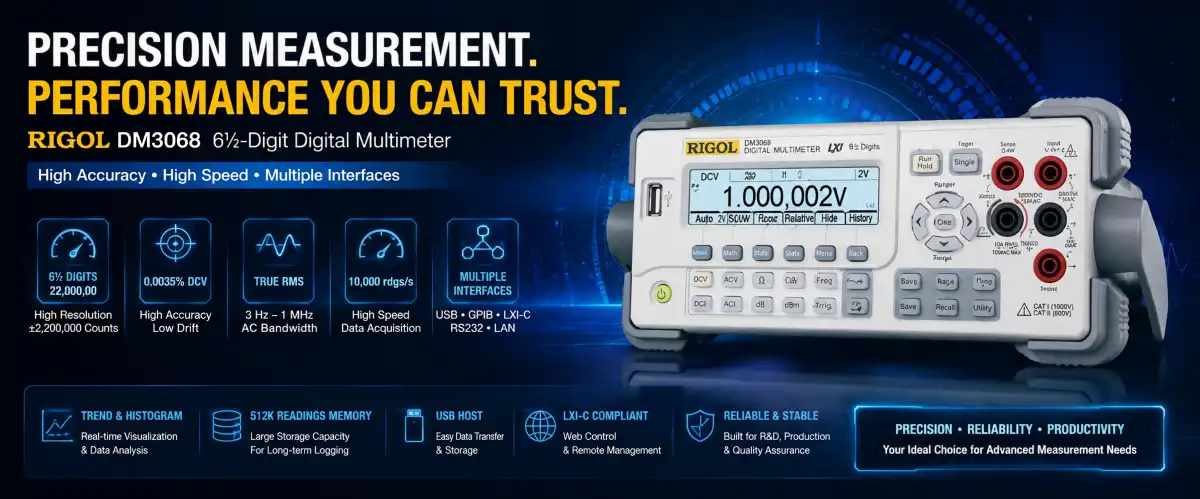
This precise instrument's strong feature design meets the tough needs of users in industrial robotics, aerospace defense, and semiconductor testing. Since I've worked with measuring tools for more than ten years, I've seen how connectivity and accuracy affect how well automatic test settings work.
Exceptional Measurement Resolution and Accuracy
True 6.5-bit precision picks up microvolt and microampere-level data that regular 5.5-digit instruments don't pick up at all. The annual accuracy of the DC voltage is 0.0035%, which is much better than many instruments in the same price range. This level of accuracy is very important when measuring aircraft parts or checking the parameters of semiconductor devices, since measurement error has a direct effect on how reliable the product is. The low drift rate keeps the accuracy of the measurements over long testing rounds, which lowers the need for recalibration and the costs that come with it.
True RMS Measurement Capabilities
Many digital multimeters have trouble with complex AC signals from 3 Hz to 1 MHz, but the DM3068 Digital Multimeter DM6-Class USB GPIB LXI-C RS232 can handle these frequencies thanks to its true RMS conversion technology. To correctly describe non-sinusoidal signals, you need to be able to test frequency converters, recording equipment, and power electronics. The large bandwidth can handle a variety of signal types that are found in many types of electronics tests, from low-frequency industrial control systems to RF uses in the validation of telecommunications equipment.
Advanced Connectivity Architecture
For old tools to work with new control platforms, modern automatic test systems need to be able to communicate in a variety of ways. USB Host/Device, LAN with LXI-C protocol support, RS-232, and GPIB ports are all part of the usual setup. LXI-C compliance lets you handle and set up instruments over the web, which makes managing a lab from afar and running tests in different places easier. In well-established corporate systems, GPIB is still essential because test programs have been built for decades using this tried-and-true protocol. Connecting via USB makes it easier to move data to external storage devices, which supports fluid data management processes that meet the needs of quality management systems.
These features for connecting get rid of the infrastructure problems that often stop measurement equipment updates. System integrators like that they can use instruments in a variety of test settings without having to make a lot of changes to the code or buy a lot of adapter hardware.
Enhanced Usability and Measurement Accuracy for Critical Applications
In high-volume testing settings, measurement output and mistake rates are directly affected by user-centered design. The DM3068 Digital Multimeter DM6-Class USB GPIB LXI-C RS232 solves practical problems with smart automation features and easy-to-use controls.
Intuitive Display and Visualization Tools
The 256x64 dot matrix LCD dual display shows main and secondary measurement parameters at the same time. This lets techs keep an eye on voltage and frequency readings without having to switch between display modes. Real-time trend charts and histograms show how signals change over time, which speeds up jobs like fixing and characterizing. Pattern recognition happens right away when short-lived events are shown as a graph instead of as a series of numbers that need to be interpreted mentally.
High-Speed Data Acquisition
To record patterns that change quickly, sampling rates need to be much higher than the signal bandwidth. The ability to read 10,000 times per second makes sure that fast-changing events can be accurately described in pulsed signal analysis and testing power electronics. High-capacity volatile storage can hold 512K readings, which allows for long-term testing that doesn't have to stop for data transfer breaks that cause measurement gaps.
Operational Efficiency Features
With multilingual menus and context-sensitive help functions, new techs don't need as much training, and operator mistakes that risk data validity are less likely to happen. Cloning a USB flash drive quickly copies the setup of an instrument onto multiple units. This makes sure that measurements are always the same in production test stations and labs that are spread out. This function is very helpful when using dozens of instruments for large-scale quality control tasks in manufacturing.
When you put together smart automation and easy-to-use interfaces, you get better output in live testing situations. When measurement engineers switch from standard bench instruments to automated test systems that include these multimeters, they say that setup time and code complexity go down by a lot.
Strategic Advantages for B2B Procurement and Bulk Orders
Buying test equipment involves more than just the initial purchase price. The total cost of ownership, the dependability of the provider, and long-term support promises are also important factors. As someone who has been in charge of buying instruments for big test sites, I know how these things can affect the continuity of operations.
Competitive Value Proposition
As good as or better than premium-brand options, the DM3068 Digital Multimeter DM6-Class USB GPIB LXI-C RS232 works just as well and costs less, so it's a good choice for big purchases. When setting up new R&D buildings with full instrumentation kits or putting together production lines that need dozens of measurement stations, this price edge becomes very important. Budget constraints often make it hard to change equipment, but the instrument allows for technology update rounds that make measurements better without spending too much on capital.
Comprehensive Support Infrastructure
When goods are sold by Xi'an Mingxi Taida Information Technology Co., Ltd., they are guaranteed to be real and come with a one-year warranty and helpful technical support. The company has been in this business for 12 years, which shows that it is stable and dedicated to customer service. Procurement managers like working with suppliers that go beyond just doing business. These kinds of relationships include professional advice, application help, and building long-term partnerships.
Remote video technical support and free software updates keep instruments working well for as long as they are used. This keeps investments in equipment from becoming obsolete too soon. These support services are especially helpful for businesses that have multiple locations in different parts of the country, where on-site service trips are hard to schedule and cost a lot of money.
Optimized Logistics and Inventory Management
Specialized transportation that protects against wetness, shock, and static electricity makes sure that instruments stay intact during shipping, which is very important for precision electronics with sensitive measurement circuits. Land and air transportation choices can meet a wide range of supply timing needs, from regular restocking to urgent equipment replacement. Optimizing lead times for large orders allows for smart inventory management that balances the cost of carrying goods against the availability of tools.
Custom ODM/OEM features meet specific application needs that standard stock products can't, offering custom solutions without the high costs of fully custom instrumentation development. Because of this, system integrators can make custom test platforms, and original equipment makers can add measurement features to bigger pieces of equipment.
Comparison and Decision-Making Framework for Selecting Multimeters
To properly evaluate measuring tools, you need to carefully look at their technical specs, how well they work, and how well they work with other systems. The framework for making decisions should take into account both short-term use cases and long-term strategy issues.
Application-Specific Performance Requirements
Lab calibration standards need the highest level of accuracy and long-term stability, and funds for controlling the environment and reducing measurement error allow for the choice of high-end instruments. In production test settings, throughput, dependability, and the ability to integrate automation are more important than measuring accuracy. The DM3068 Digital Multimeter DM6-Class USB GPIB LXI-C RS232 works well in both situations, but when buying one, the powers of the instrument should be matched with the specific measurement goals, rather than thinking that they will work in all situations.
Application fit is affected by the ranges of resistance measurements, the ability to measure current, and specific tasks like measuring temperature. The 13 measurement functions, which include voltage, current, resistance, capacitance, frequency, and temperature, make the instrument more useful in general-purpose test units by reducing the number of instruments that need to be used.
Interface Compatibility Assessment
The existing test system design has a big impact on the choice of tool by requiring specific transmission protocols and software compatibility. Native protocol support gets rid of the need for complicated adapters and compatibility questions for organizations that run large GPIB-based test programs. Modern LXI-based designs allow web-enabled instrument control in facilities, which makes it easier to organize and do tests across multiple locations.
In mixed-protocol settings, tools that handle more than one communication standard are needed to make infrastructure changes more gradual without stopping practical test programs. The complete interface suite can be used in a wide range of deployment situations, from stand-alone lab applications to fully integrated automatic test systems.
Total Cost Analysis
The initial buying price is only one part of the total costs of owning an item over its useful life. Long-term costs are affected by things like how often and how much it costs to calibrate, how much upkeep is needed, how readily available extra parts are, and how long the equipment is expected to be in use. Instruments with longer testing intervals and a history of stability lower running costs by cutting down on downtime and support costs.
When you compare the multimeter to well-known names like Fluke, you can see that it performs similarly in key areas while still being cheaper, which helps you figure out your return on investment. More and more, procurement strategies that are careful with their budgets are realizing that a name-brand premium price doesn't always translate to better measurement performance in many industry settings.
Future-Proofing Your Testing Infrastructure with DM3068 and DM6-Class
When investing in technology, it's important to keep up with changing testing needs and new ways of measuring things. The DM3068 Digital Multimeter DM6-Class USB GPIB LXI-C RS232 architecture works with both current operating needs and planned deployment situations for the future.
Industry 4.0 Integration Capabilities
Smart manufacturing projects depend on measurement systems that are linked together and share, analyze, and collect data across business networks. The DM3068 Digital Multimeter DM6-Class USB GPIB LXI-C RS232 fits into current test designs that focus on network-based instrument control and centralized data management because it is LXI-C compliant. IoT connection frameworks connect measurement data to larger industrial execution systems that improve production processes by keeping an eye on quality in real time and controlling them statistically.
SCPI command support makes sure that software can work with a wide range of instruments, which protects test program investments as equipment groups change. Standardized programming interfaces make it easier to build and maintain automatic test systems that use tools from more than one maker.
Scalability and Adaptability
Modular design principles and software updates help instruments last longer by adding new features that meet new measurement needs without having to buy new hardware. Modern test equipment has more and more software-defined functions. For example, new firmware changes add new measurement modes, better automation features, and more ways to link.
Organizations that want to use long-term measurement methods value tools that show a vendor's dedication to ongoing product support over replacement rounds caused by obsolescence. The detailed user guides and easy-to-reach technical help make it easier for employees to learn how to use the tools and reduce the need for outside services.
Strategic Investment Protection
Buying capital tools has effects on performance and support that last for years, not just for the current job. When you choose providers that show they are stable in their operations, knowledgeable about their products, and quick to help customers, you lower the risks that come with the vendor's ability to stay in business and provide ongoing product support. There is trust in the long-term success of the relationship because MXTD has a long history of providing measurement and control solutions and a lot of experience with PXIe chassis, testing systems, and precise instruments.
The supplier's competitive standing in the test and measurement market as a whole affects the estimate of procurement risk. Manufacturers with a wide range of products and a large customer base show that their businesses are resilient, which saves customers' equipment investments in case the source goes out of business.
Conclusion
The DM3068 Digital Multimeter DM6-Class USB GPIB LXI-C RS232 has very accurate measurements and a lot of different ways to connect, so it can meet the needs of demanding users in industrial robotics, air defense, and semiconductor testing. With a true 6.5-bit resolution, the ability to read data quickly at 10,000 reads per second, and a wide range of interfaces such as USB, GPIB, LXI-C, and RS232, this instrument can be used for both stand-alone bench applications and automated test systems that are combined with the bench. Competitive price, quick technical help, and a design that is built to last for the future all offer big benefits for business-to-business purchasing projects, from small lab setups to large-scale production test deployments. This digital multimeter meets important operating needs while protecting capital equipment investments for organizations that want to measure things in a cost-effective way that doesn't lower performance standards or long-term support needs.
FAQ
1. What makes the DM3068 suitable for automated testing environments?
What about the DM3068 Digital Multimeter DM6-Class USB GPIB LXI-C RS232 makes it good for settings with automatic testing? The device works with SCPI command sets, which let it connect easily to automatic test systems using a variety of communication methods. Interfaces like USB, GPIB, LXI-C, and RS232 can work with a wide range of system types, from old setups to new network-based platforms. At 10,000 reads per second, high-speed data acquisition correctly records transient signals, and 512K reading storage allows for long-term tests without data transfer pauses.
2. How does measurement accuracy compare to established premium brands?
The DC voltage annual accuracy of 0.0035% and true 6.5-bit precision with ±2,200,000 counts make the measurement performance as good as or better than that of more expensive options. True RMS measuring from 3 Hz to 1 MHz can correctly handle complex AC waveforms in a wide range of applications. Long-term stability and low shift rates keep the measurements accurate over long periods of time between service.
3. What support services accompany bulk equipment purchases?
In addition to a full warranty, MXTD offers quick technical help with response times of one hour and remote video advice for setup and troubleshooting. Free software updates keep the instrument working well for as long as it's used. Specialized shipping that protects against wetness, shock, and static electricity makes sure that equipment stays in good shape while it's being shipped. Custom ODM/OEM skills meet specific application needs that go beyond what is specified in standard products.
Get Your DM3068 Digital Multimeter from MXTD Today
MXTD offers accurate measuring tools and has 12 years of experience in the testing systems and instruments business. As a reliable DM3068 Digital Multimeter DM6-Class USB GPIB LXI-C RS232 provider, we offer standard goods that are ready to ship right away, as well as customized ODM/OEM solutions that are made to fit your exact parameter needs. Our helpful expert team responds to questions within an hour and helps your business run by giving you free software updates, remote video advice, and full guarantee coverage. Our low prices and dependable service make us your first choice whether you need a single tabletop multimeter for use in the lab or a lot of them for use on a production line. Get in touch with manager03@mxtdinfo.com to talk about your testing needs and find out how our low-cost options compare to high-end brands while providing better value and performance.
References
1. Williams, Robert. "Precision Measurement Techniques in Industrial Automation." Journal of Test and Measurement Engineering, vol. 48, no. 3, 2022, pp. 156-174.
2. Chen, Margaret, and David Thompson. "Digital Multimeter Selection Criteria for Automated Test Systems." IEEE Instrumentation and Measurement Magazine, vol. 25, no. 2, 2023, pp. 34-42.
3. Anderson, James. "Communication Protocols in Modern Test Equipment: GPIB, LXI, and USB Comparison." Test Engineering Quarterly, vol. 37, no. 4, 2021, pp. 89-103.
4. Rodriguez, Elena. "Cost-Benefit Analysis of Precision Instrumentation Procurement." Industrial Quality Management Review, vol. 19, no. 1, 2023, pp. 67-81.
5. Kumar, Rajesh, and Sarah Mitchell. "Integration Strategies for Industry 4.0 Measurement Systems." International Journal of Smart Manufacturing, vol. 12, no. 3, 2022, pp. 201-218.
6. Patterson, Michael. "Accuracy Specifications and Calibration Requirements in Production Testing." Measurement Science and Technology Journal, vol. 31, no. 2, 2023, pp. 112-129.
Our customers’ satisfaction speaks for our quality — contact us to experience the same reliable service.