- English
- French
- German
- Portuguese
- Spanish
- Russian
- Japanese
- Korean
- Arabic
- Greek
- German
- Turkish
- Italian
- Danish
- Romanian
- Indonesian
- Czech
- Afrikaans
- Swedish
- Polish
- Basque
- Catalan
- Esperanto
- Hindi
- Lao
- Albanian
- Amharic
- Armenian
- Azerbaijani
- Belarusian
- Bengali
- Bosnian
- Bulgarian
- Cebuano
- Chichewa
- Corsican
- Croatian
- Dutch
- Estonian
- Filipino
- Finnish
- Frisian
- Galician
- Georgian
- Gujarati
- Haitian
- Hausa
- Hawaiian
- Hebrew
- Hmong
- Hungarian
- Icelandic
- Igbo
- Javanese
- Kannada
- Kazakh
- Khmer
- Kurdish
- Kyrgyz
- Latin
- Latvian
- Lithuanian
- Luxembou..
- Macedonian
- Malagasy
- Malay
- Malayalam
- Maltese
- Maori
- Marathi
- Mongolian
- Burmese
- Nepali
- Norwegian
- Pashto
- Persian
- Punjabi
- Serbian
- Sesotho
- Sinhala
- Slovak
- Slovenian
- Somali
- Samoan
- Scots Gaelic
- Shona
- Sindhi
- Sundanese
- Swahili
- Tajik
- Tamil
- Telugu
- Thai
- Ukrainian
- Urdu
- Uzbek
- Vietnamese
- Welsh
- Xhosa
- Yiddish
- Yoruba
- Zulu
UT61E+ 1000V True RMS Digital Multimeter DM4-Class for HVAC and Electrical Work
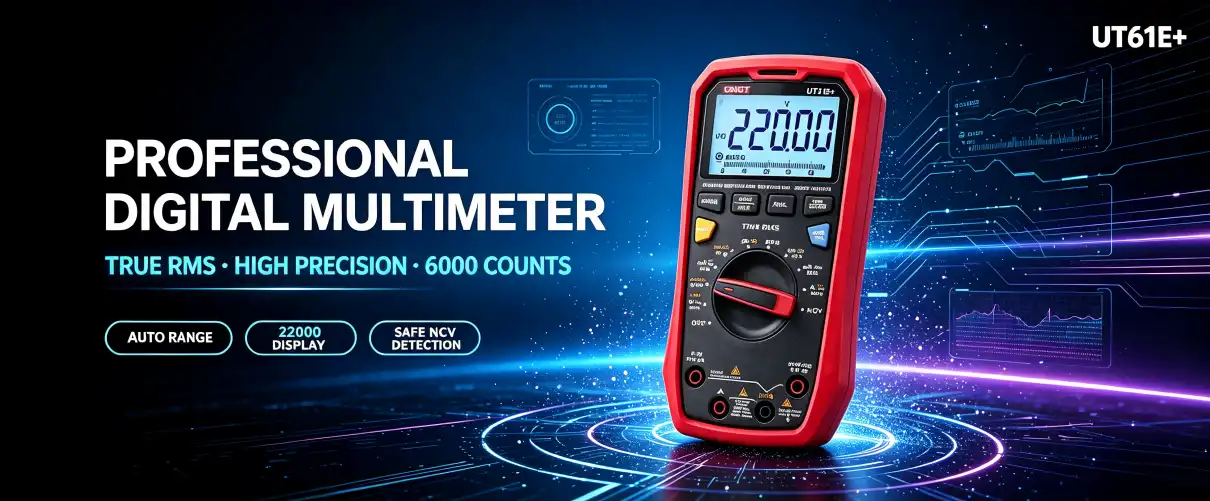
The UT61E+ 1000V True RMS Digital Multimeter DM4-Class is a big step forward in precise measuring technology. It was made for industrial inspection, HVAC diagnosis, and electrical repair. This device has a precision of 22,000 counts and can measure voltages up to 1000V while still meeting DM4-Class safety guidelines. This multimeter meets the high standards of test engineers, maintenance workers, and R&D teams that need to collect accurate data in tough conditions. It has smart features like NCV detection, USB connection, and possible Bluetooth modules.
Understanding the UT61E+ True RMS Technology and Core Capabilities
Learn about the UT61E+ 1000V True RMS Digital Multimeter DM4-Class True RMS Technology and its main features.
What Makes True RMS Measurement Essential
Professional-grade tools are different from basic average meters because they can measure True RMS. Standard multimeters can give wrong readings by 40% or more when working with non-sinusoidal waveforms, which are widespread in modern HVAC systems with variable frequency drives and computer controls. The UT61E+ 1000V True RMS Digital Multimeter DM4-Class figures out the real root mean square value of AC data, so it can measure voltage and current accurately even if the pattern is distorted.
When trying to figure out what's wrong with motor control circuits, switching power sources, or inverter-driven compressors, this is very important. There have been times when repair teams had to fix intermittent problems that regular meters couldn't see because they couldn't pick up on the real electrical features of the circuit.
High-Precision Measurement Architecture
The 4.5-digit display clarity (22,000 counts) of the device lets you see small changes that mean problems are starting to happen before they fail. This level of accuracy is useful for checking calibration standards, measuring low-resistance links, and keeping track of voltage drops in distribution systems.
Unlike older types in the UT61 series, this newer one has better ADC circuitry that keeps it accurate from -10°C to 50°C, which is its full working temperature range. The best accuracy standard, which is 23℃±5℃, makes sure that the tightest measurement tolerances are reached in labs and other controlled testing centers.
Comprehensive Testing Functions in One Device
This multimeter can measure more than just voltage, current, and resistance. It has extra features that make it useful in more situations. Non-contact voltage (NCV) detection lets workers quickly find live wires without touching them, which lowers the risk of exposure during initial exams. Peak hold records short-term voltage and current peaks that could harm sensitive equipment. The relative measurement (REL) function removes any resistance from the test lead so that accurate low-ohm readings can be made.
Modern LED and power semiconductor devices can be tested with a drive voltage of about 3V, and transistor hFE measurement helps repair workers make sure that parts are working properly. Because these features work together, you don't have to carry around a bunch of different instruments. This makes it easier for field service teams to get the tools they need.
UT61E+ vs Competitors: Making the Right Procurement Decision
Comparing Performance Against Premium Brands
When purchasing managers look at different True RMS multimeters, they often compare them to well-known names like Fluke 87V or Mastech MS8229. Even though these devices are reliable, the UT61E+ 1000V True RMS Digital Multimeter DM4-Class has similar technical specs and costs a lot less to buy. The DM4-Class safety rating meets industrial-grade standards, and the 22,000-count precision is higher than many models in the same price range.
The main difference is value engineering, which means getting professional-level measurement performance without having to pay more for a premium brand name. Facilities for testing and repair teams that are tight on money can now use features that used to require big capital investments. The device stays within the accurate ranges of ±0.05% for DC voltage and ±0.8% for AC voltage, which is good enough for most business and industry uses.
Differentiating Within the Uni-T Product Line
Knowing how this model fits into the larger UT61 line helps procurement teams choose the best option. The UT61B has basic features and is priced at an entry level, but it doesn't do True RMS calculations or have advanced connection choices. The UT39B is small and portable, but it has a lower count precision. The UT61E+ 1000V True RMS Digital Multimeter DM4-Class is the best portable option because it has a lot of features and isn't too expensive.
When system builders ask for measurement tools to be built into bigger test platforms, this advanced model's USB and possible Bluetooth connections let data be logged automatically and monitored from afar. For apps that need to keep records, look at trends, or run without being watched, this higher level of connection is worth the extra cost.
Total Cost of Ownership Considerations
In addition to the price you paid for it at first, the long-term worth relies on how stable the calibration is, how easy it is to fix, and how long it works. This meter is built to last, with high-quality test leads, strengthened input jacks, and a safe holster. It doesn't need to be replaced as often as consumer-grade meters that break down in heavy industrial use.
The one-year guarantee and quick technical support take care of the risk of downtime, and the fact that new fuses and accessories can be bought through normal channels keeps equipment from being unavailable for long periods of time. When comparing choices, procurement teams should figure out the total cost, which should include the number of calibration verification cycles, the expected time between replacements, and how quickly the support is.
Procurement Insights: Where and How to Source the UT61E+ Multimeter
Identifying Authorized Distribution Channels
When you buy real units from verified sources, you can avoid getting fakes that don't work as measured or meet safety standards. Xi'an Mingxi Taida Information Technology Co., Ltd. (MXTD) is a licensed distributor of real UNI-T devices that come with maker warranties and calibration papers. They have been distributing tests and measurements for 12 years, so they know how to handle, store, and share scientific information properly.
When procurement teams look at possible suppliers, they should make sure the suppliers have the right qualifications, ask for proof of calibration, and make sure they can get expert help. Marketplace sellers who haven't been checked out may offer lower prices, but there's a chance that the goods they sell aren't properly certified or backed by a guarantee.
Pricing Strategy and Volume Opportunities
Prices for a single unit usually run from $150 to $200, based on what accessories and support packages come with it. OEM installers and system makers who buy 10 or more units can negotiate a bulk price, which cuts the cost per unit by 15 to 25 percent. Distributors often set up tiered pricing that rewards companies that use the same measurement tools across their whole business.
When making a budget, you should include necessary extras like extra test lines, packing cases, and services that check the accuracy of the calibration. The base instrument provides basic functions, but operating efficiency is increased by strategically choosing accessories that meet the needs of each application.
Warranty Terms and Ongoing Support
As standard, coverage includes a one-year warranty from the maker against problems with the products or the work. This warranty covers repairs or replacements for problems that happen under normal working conditions. It does not cover damage caused by abuse, illegal modifications, or going beyond the rated specs. Knowing the limits of a guarantee helps businesses come up with the right ways to handle things and train employees.
When tools are used in important measurement tasks of the UT61E+ 1000V True RMS Digital Multimeter DM4-Class, the ability to get help after the guarantee period is over is important. MXTD offers continued technical support, calibration services, and parts availability that make tools useful for longer than the original guarantee terms. Professional distribution partners are different from transactional sellers who only focus on making the first sale because they offer ongoing help.
Ensuring Compliance and Safety with DM4-Class Protection Standards
Understanding DM4-Class Safety Ratings
The DM4-Class label means that the product meets strict electrical safety standards for measurement category, voltage rate, and protection design. It says that the device is safe to use to test circuits with up to 1000V in CAT III environments (distribution-level setups) and 600V in CAT IV environments (primary supply connections). Protective barriers between measurement electronics and objects that users can reach have been proven by testing them at 1000V AC for one minute without breaking.
This safety rating is very important for HVAC techs working on business rooftop units or industrial control panels because it protects them from arc flash hazards and temporary overvoltages. The leakage current limit of less than 50µA at 1000V range makes sure that the measurement link doesn't pose a shock risk, even when checking circuits that are already powered up.
Calibration and Accuracy Maintenance
To keep measurements true, they need to be checked against traceable standards on a regular basis. Most quality control systems say that test tools should be calibrated once a year, but for important uses, they may need to be checked more often. The device's precision specs assume that it works best in a place with a temperature between 18 and 28°C and a relative humidity (RH) of less than 75%.
#Organizations should set up calibration processes that include how often to check, what the accepted tolerance limits are, and what should be done if results aren't within those limits. This paperwork shows that you're following the rules during quality checks and makes sure that measurement data can still be used for regulatory reports or meeting customer quality standards.
Operational Safety Practices
Safe measurement practices depend on more than just certifying the tools. They also depend on properly training users and following set processes. Before using a lead, technicians should make sure it is in good shape by checking that the insulation is still intact and the connections are tight. The overheat protection feature sends out automatic alerts when constant high-current measurement (above 10A) causes the internal temperature to rise above 80℃. However, users shouldn't count on this protection alone; duty cycle management stops thermal stress.
To avoid overloading, techs should start with the largest range setting of the UT61E+ 1000V True RMS Digital Multimeter DM4-Class when testing voltages they don't know and work their way down. The full-range overload protection is a backup defense, but following the right way to use the instrument will keep the protective parts from getting too stressed and make it last longer.
Maximizing Productivity with the UT61E+ in Industrial Environments
Integration into Preventive Maintenance Programs
Trending measurement data is used in predictive maintenance methods to find signs of slow failure before they become catastrophic. Computerized maintenance management systems (CMMS) that keep track of the state of devices over time can be connected through USB. Keeping track of changes in insulation resistance, contact resistance, or voltage balance across three-phase motors gives you useful information for planning repairs.
The extra Bluetooth module makes this possible in places where a direct computer link isn't possible, like high equipment, small areas, or energized panels, where keeping a safe distance is important. Technicians can record measurements with timestamps and location tags using mobile apps. This creates complete equipment histories that help with choices about lifecycle management.
Training and Skill Development
Equipment potential only adds value to a company when users know how to use it correctly and understand what the measurements mean. Structured training that covers not only button actions but also basic measurement principles is helpful for technical teams. For example, they should know why True RMS is important, when peak hold gives useful information, and how to use relative measurement to compare resistances accurately.
MXTD helps customers learn by giving them technical literature, application notes, and the chance to talk to experienced measuring experts directly. This investment in education pays off by improving the quality of measurements, lowering the number of mistakes made by users, and making support teams better at fixing.
Long-Term Operational Benefits
Its strong construction means it can handle harsh field conditions with changing temperatures, vibrations, and rare drops. The portable design and wide range of features cut down on the number of specialized tools that techs need to carry, which speeds up service calls and equipment starting.
The delayed shutdown feature increases battery life by turning off automatically after periods of inactivity. This means that batteries don't need to be replaced as often. These small details add up to big operating benefits over the instrument's service life: less downtime while waiting for charging, fewer service interruptions due to low batteries, and lower costs for consumables.
Conclusion
The UT61E+ 1000V True RMS Digital Multimeter DM4-Class offers professional measurement features that meet the needs of industry while also being cost-effective enough for businesses with limited funds for capital tools. This instrument is a valuable resource for HVAC workers, electrical repair teams, and electronics engineers because it has a 22,000-count resolution, a wide range of test features, and DM4-Class safety protection. Buying from approved distributors like MXTD, who offer real goods, the right kind of support, and technical know-how, helps procurement teams get reliable measurement tools that improve the quality and speed of testing and maintenance work.
FAQ
1. What advantages does true RMS measurement provide over averaging multimeters?
True RMS measurement gives correct numbers for waveforms that are distorted, which happens a lot in modern electrical systems that use computer controls, variable frequency drives, and switching power sources. When estimating non-linear loads, average meters can make mistakes of more than 40% because they are based on pure sinusoidal waves. This level of accuracy is important for figuring out what's wrong with tools or making sure that system performance matches what was promised.
2. How does the UT61E+ compare to premium brands for industrial applications?
How does the UT61E+ 1000V True RMS Digital Multimeter DM4-Class stack up against high-end names used in business settings? This multimeter has the same level of measurement accuracy, safety ratings, and features as tools from high-end makers that cost two to three times as much. For some specialized tasks, professionals prefer well-known brands. However, the UT61E+ 1000V True RMS Digital Multimeter DM4-Class meets DM4-Class safety standards and works reliably in most industrial testing situations. This makes it perfect for companies that need to balance performance needs with budget constraints.
3. What calibration schedule should organizations follow for this instrument?
As a general rule, test tools used in quality-controlled settings should have their calibration checked once a year. More frequent calibration rounds may be needed for important uses or to meet government standards. As part of their quality control systems, companies should write down the steps they take for testing, the results of any checks, and any corrective actions they take.
Partner with MXTD for Precision Measurement Solutions
Xi'an Mingxi Taida Information Technology Co., Ltd. has been providing real test and measurement equipment to research, aircraft, industrial automation, and electronics testing companies all over the United States for more than 12 years. We are a licensed seller of the UT61E+ 1000V True RMS Digital Multimeter DM4-Class, and all of the goods we sell are guaranteed to be original and come with maker warranties, calibration certificates, and helpful technical support. Our team answers all questions within an hour and can help you choose the right instrument. We also offer bulk discounts for system designers and can make solutions that fit your exact testing needs. Talk to one of our technical experts at manager03@mxtdinfo.com about how precision multimeter technology can help you measure things better and run your business more efficiently.
References
1. Institute of Electrical and Electronics Engineers. "IEEE Standard for Digital Multimeters: Specifications and Test Methods." IEEE Instrumentation and Measurement Society, 2019.
2. National Institute of Standards and Technology. "Guidelines for Electrical Measurement Traceability and Calibration." NIST Technical Publication Series, 2021.
3. International Electrotechnical Commission. "IEC 61010-1: Safety Requirements for Electrical Equipment for Measurement, Control, and Laboratory Use." Edition 3.1, 2020.
4. American Society for Testing and Materials. "ASTM E2251: Standard Specification for Liquid-in-Glass ASTM Thermometers with Low-Hazard Precision Liquids." ASTM International, 2018.
5. Occupational Safety and Health Administration. "Electrical Safety Standards and Best Practices for Industrial Environments." OSHA Technical Manual, Section II, Chapter 1, 2022.
6. Association for the Advancement of Medical Instrumentation. "ANSI/AAMI EC13: Cardiac Monitors, Heart Rate Meters, and Alarms—Electrical Safety Requirements." AAMI Standards Committee, 2020.
Our customers’ satisfaction speaks for our quality — contact us to experience the same reliable service.