- English
- French
- German
- Portuguese
- Spanish
- Russian
- Japanese
- Korean
- Arabic
- Greek
- German
- Turkish
- Italian
- Danish
- Romanian
- Indonesian
- Czech
- Afrikaans
- Swedish
- Polish
- Basque
- Catalan
- Esperanto
- Hindi
- Lao
- Albanian
- Amharic
- Armenian
- Azerbaijani
- Belarusian
- Bengali
- Bosnian
- Bulgarian
- Cebuano
- Chichewa
- Corsican
- Croatian
- Dutch
- Estonian
- Filipino
- Finnish
- Frisian
- Galician
- Georgian
- Gujarati
- Haitian
- Hausa
- Hawaiian
- Hebrew
- Hmong
- Hungarian
- Icelandic
- Igbo
- Javanese
- Kannada
- Kazakh
- Khmer
- Kurdish
- Kyrgyz
- Latin
- Latvian
- Lithuanian
- Luxembou..
- Macedonian
- Malagasy
- Malay
- Malayalam
- Maltese
- Maori
- Marathi
- Mongolian
- Burmese
- Nepali
- Norwegian
- Pashto
- Persian
- Punjabi
- Serbian
- Sesotho
- Sinhala
- Slovak
- Slovenian
- Somali
- Samoan
- Scots Gaelic
- Shona
- Sindhi
- Sundanese
- Swahili
- Tajik
- Tamil
- Telugu
- Thai
- Ukrainian
- Urdu
- Uzbek
- Vietnamese
- Welsh
- Xhosa
- Yiddish
- Yoruba
- Zulu
UT501A Insulation Resistance Tester for Motor and Cable Testing
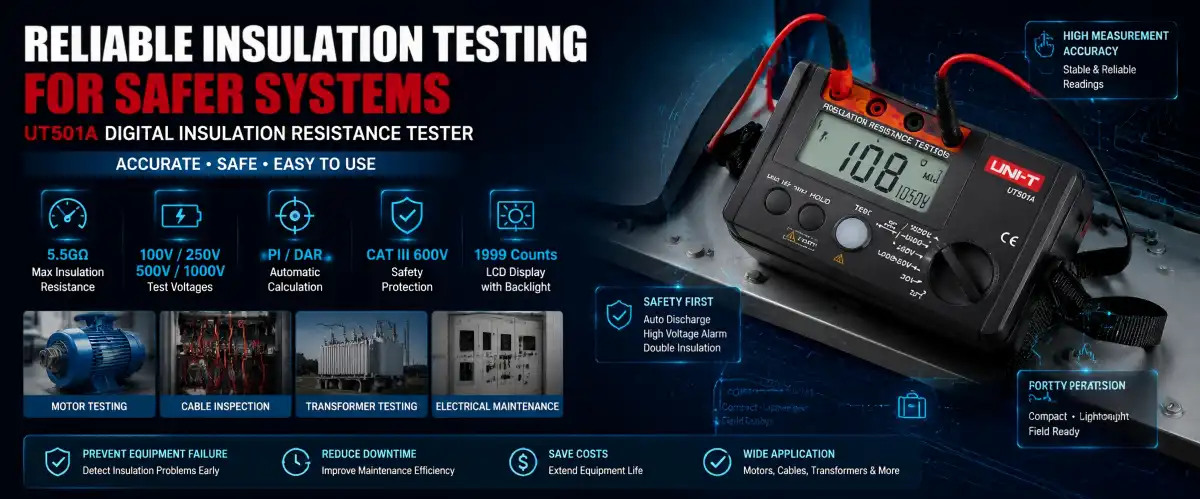
The UT501A Insulation Resistance Tester is a cheap digital megohmmeter that checks insulation resistance in motors, wires, and electrical systems. It has a measurement range of up to 5.5GΩ and four voltage output sets (100V, 250V, 500V, and 1000V). This basic UT500 series instrument is both accurate and easy to use, which makes it an important tool for industrial repair workers who want to keep equipment from breaking down and keep downtime to a minimum.
Institutions that work with industrial technology, aerospace, electronics testing, and research are always under pressure to keep costs down while keeping tools reliable. Electrical insulation decline is still the main reason why motors and cables break down, which can cause unexpected downtime that costs a lot of money every hour. We know what these problems are because we've worked with R&D managers and test engineers who need accurate troubleshooting tools that give consistent results without going over budget on purchases.
Insulation resistance testing is a type of preventative maintenance that finds insulation that is breaking down before it fails completely. The UT501A meets this need by giving accurate readings across a range of voltage levels. This lets workers check the health of the insulation in situations that are similar to those found in real-world operations. System designers and original equipment makers (OEMs) who need reliable testing equipment that meets international safety standards and is easy for field workers to access should buy this instrument.
Understanding the UT501A Insulation Resistance Tester
Core Measurement Capabilities and Technical Specifications
The 2000-count display precision and four preset test voltages on the UT501A Insulation Resistance Tester make it a reliable measuring tool. This digital megohmmeter uses switch-mode power source technology to produce stable DC high voltage. It has big benefits over standard hand-crank generators in terms of portability and voltage stability.
Precision in measurements is still very important for a correct insulation rating. With test voltages ranging from 100V to 1000V, the device can measure insulation resistance from 200kΩ to 5.5GΩ. This makes it useful for checking motor windings, transformer insulation, and cable connections, among other things. The low resistance measurement ranges from 0.01Ω to 200Ω, and the test current can be more than 200mA. This is made possible by four-wire measurement principles that get rid of lead resistance distortion during motor winding resistance verification.
The LCD screen on the instrument has blue backlighting to make it easy to see in poorly lit industrial settings. It shows the chosen test voltage range, battery state, overload warnings, and insulation resistance values. This 1999-count display has enough detail for most industrial insulation testing tasks, and it's easy to read, which cuts down on mistakes made when taking readings in the field.
Operating Principles and Application Scenarios
Procurement workers can better understand the UT501A's diagnostic value if they know how it works. The tester creates a controlled DC voltage that is applied across the insulation being tested while the leakage current is measured. A higher insulation resistance value means that the insulation is more stable. As insulation breaks down because of moisture damage, temperature stress, or mechanical damage, the resistance value goes down.
The automatic calculation tool for Polarization Index (PI) and Dielectric Absorption Ratio (DAR) lets you do professional testing that you'd normally only find on more expensive devices. PI compares resistance readings from 10 minutes to 1 minute, and DAR compares readings from 60 seconds to 30 seconds. These comparisons give information about how insulation is aging that simple resistance tests can't show.
Typical uses include checking the insulation of motor windings as part of preventative maintenance, testing the insulation of cables before they are installed or after damage is suspected, evaluating the insulation of transformers, and checking the insulation of switches. The UT501A is good for repair teams that do regular checks on factories, system developers who set up new systems, and quality control departments that make sure electrical parts are working properly.
Safety Features and Compliance Standards
For industrial tests, strict safety rules are needed. The UT501A has many safety features, such as CAT III 600V approval, double insulation, automatic discharge circuits, and high-voltage alarms that go off both audibly and visually when dangerous voltages are present. During tests, these safety features keep both the tools and the people who are using them safe.
Getting CE, UL, and RoHS licenses shows that you follow international safety and environmental standards. This meets purchase requirements for proof of regulatory compliance. Purchasing managers need to make sure that the tools they buy follow company safety rules and industry standards. This certification portfolio makes the process of qualifying vendors easier.
Comparing UT501A with Other Insulation Resistance Testers
Performance Against Higher-End UNI-T Models
To properly evaluate the UT501A Insulation Resistance Tester, you need to know more about the UT500 series as a whole. The UT502A has the same voltage ranges, but it can store more than 1000 test records and connects via USB for data sharing. The UT511A increases the test voltage to 2500V so that high-voltage equipment can be tested, and it also has wider measurement ranges. The UT505A BT has Bluetooth connection, which lets you send info wirelessly to mobile devices for digital storage.
The UT501A markets itself as an entry-level choice that keeps basic measurement functions while getting rid of more expensive advanced features. Customers who need reliable insulation tests but don't want to keep logs or use higher voltage ranges will benefit from this smart placement. For safety reasons, procurement managers should think about whether their testing methods need written data trails or if oral recording is enough.
Budget issues have a big impact on the choice of tools. It usually costs less than $200 to buy the UT501A, which is a big discount compared to other instruments with similar basic features that cost a lot more. Because this saves money, maintenance departments can give each worker their own tester instead of sharing limited units between teams. This makes work go more smoothly and avoids equipment problems.
Competitive Positioning Against Premium Brands
Fluke and Megger are well-known names that fetch higher prices because they have large service networks and are easy to recognize. The Fluke 1507 insulation resistance tester has similar voltage ranges, is more durable, and comes with a full guarantee, but it costs more than twice as much as the UT501A. The Megger MIT320 can measure the same things, but its user interface is designed in a way that some techs like.
When it comes to value, the MXTD UT501A is hard to beat. It has all the important measurement features, is safe, and is affordable. This balance is especially appealing to system designers who are in charge of projects that need to stay within a certain budget when it comes to setting up testing labs or field service teams. Performance specs are very similar to those of high-end competitors for normal motor and cable testing tasks. The main differences are longer guarantee coverage and techs' familiarity with the brand.
There are trade-offs between cost and performance that depend on things like measurement speed, display update rates, toughness ratings, and the infrastructure for maker support. The UT501A is good for situations where basic measurement accuracy and safety compliance are more important than these other factors. This makes it a smart choice for businesses that value cost-effective reliability over premium brand positioning.
How to Use the UT501A for Motor and Cable Testing: Step-by-Step Guide
Pre-Test Preparation and Safety Protocols
The right way to test starts before the test lines are connected. Make sure that the test equipment has been turned off and all of its saved energy has been used up. Even after the power is turned off, motor capacitors and wire capacitance can still hold dangerous voltages. This means that the right discharge steps must be followed before testing can begin. Make sure that the UT501A Insulation Resistance Tester battery state shows that it has enough charge for accurate testing, since a low battery can affect the accuracy of measurements.
Damage to test lines that could affect safety or the accuracy of measurements can be seen by touching them. Check the insulation on the lead for cracks, bare wires, or broken connection hardware. The tool has LINE (red) and EARTH (black) terminals for testing insulation resistance, as well as V and Ω connections for measuring voltage and low resistance, respectively. When checking with high voltage, making sure the leads are properly connected keeps the operator safe and stops measurement mistakes.
The quality of measurements is affected by the environment. When you test, do it when it's dry, because wetness on the surfaces of insulation can create leaks that make it look like the insulation has broken down when it hasn't. Extreme temperatures can also change insulation resistance numbers. Usually, resistance values are higher when temperatures are cooler. Keep records of the testing settings to set regular starting points for tracking the health of insulation over time.
Testing Motor Windings
To figure out how well motor winding insulation is working, tests need to be done between each part of the windings and between the windings and the motor frame ground. Set the UT501A's function setting to the test voltage you want. For motors rated at 460V or less, this is usually 500V. Connect the black EARTH lead to the motor frame or a ground connection point and the red LINE lead to the motor contact.
To start measuring, press the test button. Keep the wires stable while the device applies test voltage and checks the resistance. As insulation polarization happens, the display shows rising resistance values. For normal tests, these values usually stay the same after 60 seconds. The minimum allowed insulation resistance depends on the motor's voltage rating and industry standards. As a general rule, 1MΩ plus 1MΩ per 1000V of motor rating is a good starting point.
By comparing 10-minute and 1-minute resistance readings, the automatic PI calculation tool gives you more advanced troubleshooting information. PI values below 1.0 usually mean that the insulation is dirty or breaking down and needs to be looked into further, while values above 2.0 usually mean that the insulation is in good shape. This computerized calculation gets rid of the need to time and write things by hand, which makes testing processes easier for operators.
Cable Insulation Testing
Wire testing is similar to motor testing, but you have to think about how the length and capacitance of the wire will affect the test results. Long cable runs hold a lot of electrical charge that needs to be released before the wires can be handled after testing. Even though the UT501A has automatic discharge circuitry, it is still a good idea to ground testing wires by hand before removing test leads.
Choose the right test voltage based on the cable's grade. For cables rated 600V or less, use 500V, and for setups with higher voltages, use 1000V. LINE should be connected to the cable conductor, and EARTH should be connected to the ground wire or cable shield. To test wires with more than one conductor, you have to separate each conductor and test it against ground and other conductors to find specific insulation flaws.
People often make mistakes like checking cords without unplugging the equipment first, which can lead to parallel resistance paths that give falsely low results. Before checking, you should always disconnect all ends of a cable section and disconnect it from the rest of the system. Readings can also be messed up by surface contamination from installation chemicals or exposure to the environment, especially in outdoor setups where water builds up.
Procurement Considerations for Buying the UT501A Insulation Resistance Tester
Identifying Authorized Distributors and Avoiding Counterfeits
Buying original equipment saves your investment and makes sure that the warranty stays good. MXTD is a licensed seller of real UT501A Insulation Resistance Tester units that come with maker warranties and expert help. Fake test instruments are very dangerous because they use low-quality parts and don't have the right safety certifications. This can put users at risk of electrical dangers and put companies at risk of liability issues.
As part of the verification process, the seller's permission is checked through the maker's channels, the product packaging is checked for quality printing and security features, and serial numbers are compared to manufacturer databases when they are available. When prices are very low compared to what the market normally charges, it's likely that the goods are fake or came from the dark market without the right guarantee support. Procurement managers should make lists of accepted vendors that include verified sellers who can show proof that the products they sell are real.
MXTD has been in the measurement and control business for more than 12 years and has strict quality control procedures in place. This proven track record gives buyers peace of mind that the equipment they buy will meet their needs and get the help it needs throughout its useful life. These are important things to think about when giving repair teams safety-critical testing instruments.
Bulk Purchasing Advantages and Logistics
Industrial clients that need to supply more than one building or repair teams can save a lot of money by buying in bulk. Tiered pricing savings, which lower the cost per unit and make sure that processes use the same tools, are usually available for large orders. When compared to keeping a wide range of tools, focusing on a few specific instrument types makes training easier, keeping spare parts on hand, and planning when to do calibrations.
Shipping precise tools requires paying close attention to how the packaging is protected. With shock-proof, moisture-proof, and anti-static packaging features, MXTD can be used for both land and air transportation to keep sensitive gadgets safe while they're in transit. Talking about shipping needs during buying makes sure that the right safety measures are used for your storage conditions and the way they will be received.
Because the UT501A is so light—it weighs only 500 grams with the fabric bag and holding strap that come with it—it can be shipped cheaply even to other countries. This portability also helps field technicians who move equipment from one testing site to another, which keeps their bodies from getting tired during long testing tasks spread out over many big facilities.
Warranty Coverage and Technical Support
Long-term ownership costs are greatly affected by understanding guarantee terms and after-sales help options. The UT501A comes with a normal one-year warranty that covers manufacturing defects. MXTD also offers quick technical help through regular lines of contact. It's important for procurement managers to be clear about how to file a warranty claim, how long it takes to fix something, and whether loaner equipment is available during warranty service.
Technical support goes beyond fixing problems; it also includes application advice, which helps teams make the best use of testing methods for different types of equipment. MXTD offers free software updates and remote video technical support when needed, so the worth of the device stays high as long as it works. The company promises to answer customer questions within an hour, with a focus on the fast technology response needs that industrial clients have marked as major pain points.
The existence of a calibration service makes sure that the accuracy of measurements stays in line with national standards for the life of the device. Talk about how often to calibrate, the paperwork needed for approval, and the costs during the buying process to get an idea of the total cost of ownership, which should include the costs of regular calibration. Some companies keep their own calibration tools, while others prefer vendor-managed calibration programs that make compliance paperwork easier.
Value of the UT501A for B2B Clients in Industrial Testing
Reducing Downtime Through Predictive Diagnostics
Unexpected breakdowns of equipment mess up production plans and cause emergency repair costs that are much higher than normal testing costs. The UT501A Insulation Resistance Tester lets you use predictive maintenance methods to find insulation that is breaking down before it fails. This way, fixes can be planned for planned breaks instead of being done in an emergency. This proactive method lowers the overall cost of repair while also making equipment more reliable and keeping production going.
Maintenance teams gain from testing methods that are easier to understand and don't require a lot of training. The range selection knob and testing button are both one-button operations, so you don't have to learn how to use complicated menus that come with more advanced instruments. Technicians can focus on making sure connections are made correctly and figuring out what the results mean instead of how to operate the instruments. This cuts down on testing time and mistakes during regular inspections.
The fact that six AA batteries can last more than 120 hours is great for practical economy because it lowers the cost of consumables and makes sure that instruments can be used for long testing sessions without having to be stopped to change batteries. Field service operations that can't easily get new batteries or whose testing plans require ongoing operation during multiple shifts will benefit the most from this longer runtime.
Efficiency Gains and Cost Savings
The UT501A strikes a good mix between features and price for OEM manufacturers who want to use testing procedures as part of production quality control. By putting committed testers on different production lines, testing can be done at the same time without slowing down the workflow. This increases throughput while still meeting quality assurance standards. The instrument's small size and portability make it useful in modern manufacturing sites that don't have a lot of room for production.
System integrators who are completing systems like how flexible the testing is because it can check the integrity of the motor windings, the cables, and the voltage, all with a single, small device. This flexibility lowers the total number of tools that need to be kept on hand compared to keeping different instruments for each testing function. This makes managing equipment easier and lowers the cost of building testing infrastructure.
Distributors that work with industrial maintenance markets say that the UT501A meets the needs of a wide range of customers in many fields, such as factory automation, building maintenance, utility operations, and industrial equipment service. This wide range of uses helps with effective inventory management and gives customers options that work for a wide range of needs, from regular maintenance to complex diagnostic studies.
Integration into Comprehensive Testing Strategies
Along with electrical testing, modern repair operations use a number of other testing methods, such as thermal imaging, vibration analysis, and oil analysis. In addition to these technologies, the UT501A offers a unique way to check the health of insulation that other methods can't. By combining insulation resistance trends with other predictive maintenance data, full equipment health pictures are made that allow for smart maintenance choices and the best use of resources.
The device serves regulatory compliance requirements that require testing of insulation on a regular basis to ensure electrical safety. Documentation features, even though they are manual for this entry-level model, meet review needs when used with the right record-keeping methods. If your company needs automated paperwork, you might want to look at higher-tier models that come with built-in data storage. However, keep in mind that for many compliance systems, human writing is enough.
In terms of what will be needed in the future, the UT501A offers strong base features that will still be useful as testing programs grow. The basic measurement rules and safety features are in line with industry standards, so they will continue to be useful even as testing methods change. When you need more features, it's easy to switch to a more advanced model in the UT500 family. This protects your initial equipment purchases by using appropriate measurement methods.
Conclusion
If you're trying to save money on your purchase, the UT501A Insulation Resistance Tester is a great choice because it has all the measurement features you need for checking motors and cables in commercial settings. It has four voltage output settings, a measurement range of up to 5.5GΩ, automatic PI/DAR calculation, and a lot of safety features that make it a great choice for OEM makers, repair companies, and system integrators. The instrument meets international safety standards thanks to its CE, UL, and RoHS certifications. It also has useful benefits, such as being easy to carry, having a longer battery life, and being simple to use so that you don't need to spend much time learning how to use it. People who work in procurement who need reliable tools to test insulation will find that the UT501A meets their basic testing needs without being too complicated or costing too much like some other options.
FAQ
1. What kinds of voltages can the UT501A Insulation Resistance Tester handle?
You can choose from four test voltage sources on the device: 100V, 250V, 500V, and 1000V. This range is flexible enough to meet the testing needs of a wide range of electrical equipment, from low-voltage control circuits to normal industrial motor and wire systems rated 600V or less.
2. How does the accuracy of measurements compare to other high-end brands?
The UT501A Insulation Resistance Tester has measurement accuracy good enough for industry repair tasks, and it works about as well as standard motor and cable testers that cost a lot more. The UT501A meets the accuracy needs for predictive maintenance and compliance tests in most industrial situations, even though some higher-end brands may have slightly tighter specs or faster measurement speeds.
3. What kinds of measurements are there?
MXTD offers calibration services that make sure measurements can be tracked back to national standards. Calibration papers show that the measurements were taken correctly. Calibration times are usually set once a year, but the exact needs depend on the industry standards and internal quality systems. Talk about calibration plans during the buying process to set up service schedules that work with your business planning and compliance needs.
Partner with MXTD for Reliable Insulation Testing Solutions
The MXTD UT501A Insulation Resistance Tester is a great deal for industrial buying managers and test engineers who need reliable measuring tools. Because we are dedicated to quality and have worked in this field for 12 years, we know that each instrument must meet strict performance standards for professional use. We keep a ready supply of standard goods that can be customized to meet specific needs. We can respond to customer needs within an hour and set up production cycles that work with your project's schedule. Email our team at manager03@mxtdinfo.com to talk about the testing tools you need, to look into pricing for multiple units, or to ask for technical details. As a reliable UT501A Insulation Resistance Tester provider, we offer full warranty support, online technical assistance, and a long-term relationship that is focused on your measurement success.
References
1. IEEE Standard 43-2013, "IEEE Recommended Practice for Testing Insulation Resistance of Rotating Machinery," Institute of Electrical and Electronics Engineers, New York, 2013.
2. Palmer, R.C., "Maintenance Planning and Scheduling Handbook, Third Edition," McGraw-Hill Education, New York, 2013, Chapter 12: Predictive Maintenance Technologies.
3. Stone, G.C., Boulter, E.A., Culbert, I., and Dhirani, H., "Electrical Insulation for Rotating Machines: Design, Evaluation, Aging, Testing, and Repair, Second Edition," IEEE Press, Hoboken, 2014.
4. NETA Standards, "Standard for Maintenance Testing Specifications for Electrical Power Equipment and Systems," International Electrical Testing Association, Portage, 2019.
5. Gill, P., "Electrical Power Equipment Maintenance and Testing, Second Edition," CRC Press, Boca Raton, 2008, Chapter 4: Insulation Testing Techniques.
6. International Electrotechnical Commission, "IEC 61557-2: Electrical Safety in Low Voltage Distribution Systems - Equipment for Testing, Measuring or Monitoring of Protective Measures - Part 2: Insulation Resistance," Geneva, 2019.
Our customers’ satisfaction speaks for our quality — contact us to experience the same reliable service.