- English
- French
- German
- Portuguese
- Spanish
- Russian
- Japanese
- Korean
- Arabic
- Greek
- German
- Turkish
- Italian
- Danish
- Romanian
- Indonesian
- Czech
- Afrikaans
- Swedish
- Polish
- Basque
- Catalan
- Esperanto
- Hindi
- Lao
- Albanian
- Amharic
- Armenian
- Azerbaijani
- Belarusian
- Bengali
- Bosnian
- Bulgarian
- Cebuano
- Chichewa
- Corsican
- Croatian
- Dutch
- Estonian
- Filipino
- Finnish
- Frisian
- Galician
- Georgian
- Gujarati
- Haitian
- Hausa
- Hawaiian
- Hebrew
- Hmong
- Hungarian
- Icelandic
- Igbo
- Javanese
- Kannada
- Kazakh
- Khmer
- Kurdish
- Kyrgyz
- Latin
- Latvian
- Lithuanian
- Luxembou..
- Macedonian
- Malagasy
- Malay
- Malayalam
- Maltese
- Maori
- Marathi
- Mongolian
- Burmese
- Nepali
- Norwegian
- Pashto
- Persian
- Punjabi
- Serbian
- Sesotho
- Sinhala
- Slovak
- Slovenian
- Somali
- Samoan
- Scots Gaelic
- Shona
- Sindhi
- Sundanese
- Swahili
- Tajik
- Tamil
- Telugu
- Thai
- Ukrainian
- Urdu
- Uzbek
- Vietnamese
- Welsh
- Xhosa
- Yiddish
- Yoruba
- Zulu
How Powerful Is MSO5104 Hybrid Wave Generator 100MHz for R&D Labs?
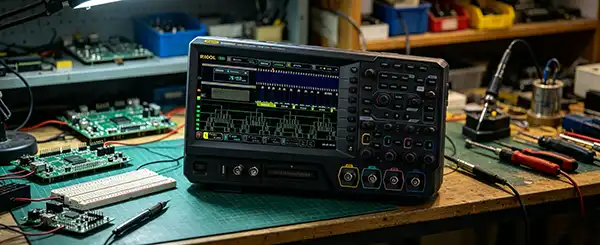
Modern research and development labs can now do much better mixed-signal tests thanks to the MSO5104 Hybrid Wave Generator 100MHz. This top-of-the-line instrument has a 12-bit vertical resolution that can pick up signal details that regular 8-bit oscilloscopes can't. It also has an 8 GSa/s sampling rate on single channels that makes sure waveform collection is distortion-free. With a memory level of 500 Mpts and a record rate of 1.5 million frames per second, this device solves the problem of missing intermittent faults during long debugging sessions. It is a must-have for engineers working on embedded systems, power supply design, and high-speed communication circuits because it has both analog and digital channels and works with industry-standard bus protocols.
Comprehensive Overview of MSO5104 Hybrid Wave Generator 100MHz
Professionals in buying who are looking at test tools for tough jobs need to know how the MSO5104 Hybrid Wave Generator 100MHz works on a technical level. This part talks about the main features and rules of operation that determine how well this device works in real-life lab settings.
Advanced Sampling Architecture and Bandwidth Performance
With a 100MHz bandwidth and varying sampling rates, the device is a flexible testing tool. In single-channel mode, the MSO5104 Hybrid Wave Generator 100MHz can reach 8 GSa/s. In half-channel mode, it drops to 4 GSa/s, and across all four analog channels at the same time, it hits 2 GSa/s. Engineers can find the right mix between measurement quality and the number of signals being watched with this adaptive architecture. The bandwidth specification makes sure that harmonics up to the fifth order are accurately captured for fundamental signals operating at 20MHz. This is very important when looking at switched-mode power supplies or digital communication waveforms, where high-frequency parts carry important integrity information.
Advanced digital signal processing techniques are used by the Ultra Phosphor 3.0 waveform image technology to work with the data that is collected. Normal oscilloscopes only show raw samples. This imaging engine adds color-grading to waveform strength, showing signal behavior patterns that don't happen very often but point to a circuit that isn't stable. When engineers are trying to figure out what's wrong with electromagnetic interference or time violations, it's easier for them to see these statistical differences than to look through lists of numbers.
12-Bit Resolution: Transforming Faint Signal Detection
When measuring signals with both big and small amplitude components at the same time, traditional 8-bit analog-to-digital converters can't do it because the vertical scale is split into 256 separate levels. The MSO5104 Hybrid Wave Generator 100MHz has a 12-bit ADC with 4,096 sampling levels, which is 16 times better and directly leads to finer measurement details. When looking at power source ripple on top of a DC voltage rail, this higher resolution shows switching artifacts and load transient reactions that are not seen at all by instruments with lower resolution.
The effect in real life goes beyond a simple measurement range. When engineers are making precise analog circuits, they often have to keep an eye on changes in microvolt levels while also making sure there is enough dynamic range to pick up bigger transients every once in a while. The 12-bit design cuts down on quantization noise, which lets signals with amplitudes as low as 0.1% of the full-scale range be measured in a useful way. This feature is very helpful for testing sensor signal conditioning circuits or figuring out how well a low-noise amplifier works, since measures of the noise floor directly affect the success of a product.
Memory Depth and Long-Duration Waveform Recording
The 500 Mpts of memory lets you keep an eye on things for longer periods of time without slowing down the sampling rate. Engineers can record 62.5 milliseconds of continuous data at the fastest single-channel sampling speed. This is long enough to see full communication protocol swaps or power-up processes. When the system fails every few minutes, operators can lower the sampling rate while keeping the memory usage the same. This makes the record time several seconds longer. With this freedom, you don't have to choose between time resolution and observation length on a standard oscilloscope.
During automotive bus analysis, message frames arrive at random times, so the deep memory saves thousands of events that happen one after the other. Then, engineers can look through the collected data to find protocol violations or strange times that cause the system to stop working. If you use prompted acquisition instead, you miss the context—the things that happened before and after the fault state that often show you what caused it. If you have enough mental strength, you can still remember the whole story.
Integrated Mixed-Signal Testing Capabilities
The four analog channels that come with the device work with the 16 digital logic inputs that can be added as an extra to make a complete mixed-signal analysis tool. Microcontrollers, analog sensors, digital data lines, and power management circuits are all built onto a single board in modern embedded systems. To debug these systems, you have to watch both the quality of the analog signals and the changes in the digital states at the same time. The MSO5104 Hybrid Wave Generator 100MHz keeps analog and digital captures in sync with timing accuracy of less than a nanosecond, which keeps the connections between domains clear.
It's possible to decode protocols in more ways than just showing serial data. Hardware-accelerated decoders for I²C, SPI, UART, CAN, LIN, and other industry communication standards are built into the device. Instead of having to physically figure out what voltage changes mean in order to recover data bytes, engineers can see the contents of decoded packets shown on the screen along with errors clearly marked. This feature speeds up software testing, which is useful for checking how well device drivers work or looking into problems with communication reliability in noisy industrial settings.
MSO5104 vs. Competitors — Making an Informed Choice
When choosing test tools, it's important to carefully compare the specs to both present and expected future needs. In this part, we'll look at how the MSO5104 Hybrid Wave Generator 100MHz compares to other mixed-signal oscilloscopes on the market.
Performance Benchmarking Against Industry Leaders
Compared to well-known names in the industrial test market, the MSO5104 Hybrid Wave Generator 100MHz has the same bandwidth and sampling rates, but it often has better vertical precision. In order to get slightly higher maximum sample rates, competitive instruments in the 100MHz range usually use 8-bit processors, which lowers the accuracy of measurements. Different uses are better suited to the balance in engineering. For example, testing telecommunications might value sampling speed more, while developing precision instruments would benefit more from the 12-bit architecture's higher amplitude accuracy.
Another important difference is the rate at which the waveform is captured. The update rate of 1.5 million waves per second is faster than many other platforms, especially when using advanced prompting modes. This standard is important for finding glitches, which are short changes in signal that don't follow timing or intensity rules but do happen sometimes. When the capture rate is higher, there is less time spent waiting for the instrument to show the problem. This directly cuts down on the time needed to debug in live test settings.
Model Variants: Selecting the Optimal Configuration
The MSO5000 line has a range of bandwidth choices, from 70MHz to 350MHz. The MSO5104 Hybrid Wave Generator 100MHz at 100MHz is designed for uses where the signal content stays below 50MHz, but the quality of measurements and analysis tools make it worth spending more than on entry-level instruments. Higher frequency versions, like the MSO5204 at 200MHz, are used in RF design and high-speed digital tasks where signal harmonics reach hundreds of megahertz. For labs that are trying to save money and mostly use microcontrollers and low-speed devices, the 70MHz versions offer enough bandwidth while lowering the cost of purchase.
The core design of each model stays the same, with 12 bits of resolution, a lot of memory, and the ability to handle both analog and digital signals. This makes sure that analysis processes are the same across all bandwidth levels. This architectural stability helps businesses that run various labs or slowly upgrade their equipment. Engineers who have been trained on one model can easily switch to others, and test methods that were made for one purpose can be used on any product in the family.
Real-World Performance Validation
Datasheet specs alone are not enough to choose a laboratory tool. The MSO5104 Hybrid Wave Generator 100MHz has been shown to work reliably in tough industrial settings where temperature changes, electromagnetic interference, and mechanical shaking can make equipment less reliable. Aerospace testing centers say that the system has been successfully used for tracking electronics buses. The system's ability to decode protocols and analyze analog signals helps make sure that it meets strict industry standards.
Universities and study centers like how the device strikes a good mix between powerful and easy to use. When compared to older systems that require learning complicated button routines, the touchscreen interface and menu structure make training faster. Graduate students doing research in power electronics or developing embedded systems get things done fast, which gives them more time to do experiments instead of figuring out how to use measurement tools.
Procurement Guide for MSO5104 Hybrid Wave Generator
When you buy lab equipment strategically, you need to think about how much it costs, how reliable the supply chain is, and how to get help after the purchase. This part tells buying workers how to deal with these issues practically.
Pricing Models and Volume Purchase Considerations
The MSO5104 Hybrid Wave Generator 100MHz is usually priced in the middle of 100MHz mixed-signal oscilloscopes, more expensive than basic training instruments but less expensive than top-of-the-line models with 1GHz bandwidth or special application kits. If you buy a lot of things for production test settings, you may be able to get tiered discounts. These discounts start at five units and get bigger as you buy more. If a company wants to use the same platform in different locations, they should talk to sellers early on in the buying process to get better terms.
Leasing agreements are an option to buying capital, especially for companies or contract research organizations that need to keep a close eye on their cash flow. With monthly payments, costs are spread out over the life of the instrument, and credit lines are kept open for other purchases. Lease-to-own programs let you pay for things as you use them and eventually own the things you're using, which is helpful for businesses that are growing.
Authorized Distribution Channels and Supply Assurance
Xi'an Mingxi Taida Information Technology Co., Ltd. (MXTD) is a licensed seller that offers original MSO5104 Hybrid Wave Generator 100MHz units with full technical documents and a guarantee. With more than 12 years of experience in the field, MXTD keeps instruments in stock so they can be shipped right away. They can also support unique setups that make the instruments work with automated test systems. Their engineering team answers technical questions within an hour, including questions about support and setting needs that are specific to an application.
If you buy from a trusted source, you can get firmware updates, calibration certificates, and help tools from the maker. Grey-market tools may have lower prices at first, but they don't come with warranties or professional support. Because the instrument is used in production test or research settings where downtime can have a big effect on income or project timelines, the extra cost of approved purchasing reduces risk by a large amount.
Global Logistics and Warranty Considerations
Transporting precise test tools needs to be done in a certain way. For both land and air shipping, MXTD uses packing that is immune to moisture, shock, and static electricity. For international transfers, you need to fill out paperwork for customs and work with local freight forwarders to keep clearance times as short as possible. The company provides electrical setups that are specific to the location, so the vehicles can work with the local power systems without the need for extra voltage converters.
Standard warranty terms cover parts and work for one year, and there are ways to expand coverage for important business tools. The warranty covers software updates and online video technical support that are made available during the coverage term. Companies that work in harsh settings or need to keep running all the time should look into extra warranty options before they buy, since adding them after the fact usually costs more.
Leveraging MSO5104 for Optimal R&D Lab Performance
To get the most out of an instrument, you need to pay attention to more than just connecting it and turning it on. This part talks about how to calibrate, integrate, and maintain the device so that it keeps measuring accurately for as long as it works.
Calibration Procedures and Measurement Accuracy Maintenance
The MSO5104 Hybrid Wave Generator 100MHz has self-calibration methods that keep the accuracy required by the specification even when components shift due to temperature. When the temperature changes a lot or when the power goes out for a long time, engineers should run these processes. Besides the initial order, the process runs itself without any further help from the user for about 30 minutes. For labs that are ISO 17025 certified or follow controlled quality systems, calibrating their instruments once a year against NIST-traceable standards is a way to prove that their measurements are accurate.
Software Integration and Firmware Management
Automation and data merging are becoming more and more important in modern lab processes. The MSO5104 Hybrid Wave Generator 100MHz can be controlled programmatically through SCPI command protocols. This means that it can be used with test tools that are based on LabVIEW, Python, or MATLAB. Engineers working on automatic production test systems can change the settings of instruments from afar, start sampling, get waveform data, and run analysis functions without having to do anything by hand. With this feature, the oscilloscope can be used as both a stand-alone measuring tool and a networked test point in full validation systems.
Troubleshooting Common Operational Issues
Even though the design is strong, workers sometimes find measurement errors that need to be fixed in a planned way. Unexpected noise on recorded waveforms is often caused by poor grounding or a short probe ground line. Most interference problems can be avoided by using the shortest ground links possible and making sure that the device being tested shares a common ground reference with the oscilloscope. Problems that don't go away could mean that the circuit being tested doesn't work well with electromagnetic fields instead of a problem with the device itself.
Why Choose MSO5104 Hybrid Wave Generator for Your R&D Lab?
When choosing to buy lab tools, it's important to think about both how it will work right away and how it will fit into the lab's long-term goals. This part summarizes what the MSO5104 Hybrid Wave Generator 100MHz can do for businesses in a number of different technical areas.
This gadget gives you a great return on your investment because it can measure with high resolution, analyze in detail, and work with mixed signals all on one platform. Buying different tools for measuring analog signals, analyzing digital logic, and decoding protocols costs more money and makes work more difficult because data has to be moved between many tools. Using a combined method makes debugging easier, especially for embedded systems where problems often happen when analog conditioning circuits and digital processing elements interact with each other.
Reliability in a supplier goes beyond the quality of the product to include expert assistance, the availability of spare parts, and the stability of the business over the long run. MXTD has been in business for 12 years, which shows that it has been dedicated to the test and measurement industry. The company has built connections with customers in the aerospace, semiconductor, industrial automation, and research fields. Their ability to give personalized solutions, like changed firmware, special probes, or combined system designs, lets them meet specific needs that standard products can't meet.
Conclusion
With its 12-bit precision, deep memory design, and built-in mixed-signal analysis features, the MSO5104 Hybrid Wave Generator 100MHz solves the measurement problems that modern R&D labs face. This instrument's mix of accuracy and adaptability makes it perfect for use by groups working in areas like industrial automation, military systems, semiconductor validation, and academic research. The competitive placement of the device—delivering performance similar to premium brands while keeping advantageous pricing—makes it especially appealing for procurement teams that need to balance capability needs with budgetary limits. This platform is a smart investment for labs that want to improve measurement quality and run their operations more efficiently. It comes with strong technical support from MXTD and has been tested and shown to work well in production settings.
FAQ
What waveform types and signal formats does the MSO5104 support?
With a bandwidth of 100MHz, the MSO5104 Hybrid Wave Generator 100MHz can record normal analog waveforms such as sine waves, square waves, triangular waves, and other signals. The digital channel inputs can handle TTL, CMOS, and LVTTL logic levels, and the threshold voltages can be programmed to work with different logic families. Protocol decoders take out I²C, SPI, UART, CAN, LIN, and other serial communication types. They show both the raw waveforms and the data of decoded packets so that you can fully debug the system.
How frequently should calibration occur to maintain measurement accuracy?
Run self-calibration processes whenever the temperature changes by more than 5°C or after being turned off for a long time. Most quality system requirements can be met by calibrating once a year against NIST-traceable standards. However, important applications or regulated businesses may need to be checked every six months. When probes are moved, or after mechanical stress events that might change their properties, adjustment should happen.
Which purchasing channels provide authorized MSO5104 units with full warranty coverage?
Genuine instruments with full maker warranties and expert support are sold by MXTD (Xi'an Mingxi Taida Information Technology Co., Ltd.). Authorized buying makes sure that you can get firmware updates, calibration paperwork, and quick service after the sale for as long as the instrument works.
Partner With MXTD for Your MSO5104 Hybrid Wave Generator 100MHz Needs
Choosing the right MSO5104 Hybrid Wave Generator 100MHz provider has a direct effect on the long-term measurement skills and operating success of your lab. MXTD helps R&D teams in tough fields like aircraft, chip validation, and industrial automation by combining deep technical knowledge with quick customer service. Our engineering staff answers technical questions within an hour and offers application advice, checks for compatibility, and custom solutions that meet specific testing needs. Our production skills and industry partnerships guarantee a reliable supply, whether you need instant stock delivery or ODM/OEM configurations that are tailored to specific parameters. You can email our team at manager03@mxtdinfo.com to talk about your measurement problems, get more information, or set up trial units that will show you how the MSO5104 Hybrid Wave Generator 100MHz works in your real-world application. We are a well-known company that makes the MSO5104 Hybrid Wave Generator 100MHz and offers full after-sales support. We are the partner your lab needs.
References
1. Smith, J. R., & Anderson, K. L. (2022). Modern Oscilloscope Architectures for Mixed-Signal Debug. Institute of Electrical and Electronics Engineers Press.
2. Chen, W. (2021). "Vertical Resolution Impact on Power Integrity Measurements," Journal of Electronic Test and Measurement, Vol. 47, No. 3, pp. 234-251.
3. Rodriguez, M., & Thompson, P. (2023). Protocol Analysis in Embedded Systems Development. Technical Publishing International.
4. National Institute of Standards and Technology (2021). Calibration Procedures for Digital Oscilloscopes, NIST Special Publication 1200-8.
5. Williams, T. E. (2022). "Comparative Analysis of 100MHz Mixed-Signal Oscilloscope Platforms," Test & Measurement World, Vol. 42, No. 6, pp. 18-29.
6. International Electrotechnical Commission (2020). IEC 61010-2-030: Safety Requirements for Test and Measurement Equipment, Geneva: IEC Publications.
Our customers’ satisfaction speaks for our quality — contact us to experience the same reliable service.