- English
- French
- German
- Portuguese
- Spanish
- Russian
- Japanese
- Korean
- Arabic
- Greek
- German
- Turkish
- Italian
- Danish
- Romanian
- Indonesian
- Czech
- Afrikaans
- Swedish
- Polish
- Basque
- Catalan
- Esperanto
- Hindi
- Lao
- Albanian
- Amharic
- Armenian
- Azerbaijani
- Belarusian
- Bengali
- Bosnian
- Bulgarian
- Cebuano
- Chichewa
- Corsican
- Croatian
- Dutch
- Estonian
- Filipino
- Finnish
- Frisian
- Galician
- Georgian
- Gujarati
- Haitian
- Hausa
- Hawaiian
- Hebrew
- Hmong
- Hungarian
- Icelandic
- Igbo
- Javanese
- Kannada
- Kazakh
- Khmer
- Kurdish
- Kyrgyz
- Latin
- Latvian
- Lithuanian
- Luxembou..
- Macedonian
- Malagasy
- Malay
- Malayalam
- Maltese
- Maori
- Marathi
- Mongolian
- Burmese
- Nepali
- Norwegian
- Pashto
- Persian
- Punjabi
- Serbian
- Sesotho
- Sinhala
- Slovak
- Slovenian
- Somali
- Samoan
- Scots Gaelic
- Shona
- Sindhi
- Sundanese
- Swahili
- Tajik
- Tamil
- Telugu
- Thai
- Ukrainian
- Urdu
- Uzbek
- Vietnamese
- Welsh
- Xhosa
- Yiddish
- Yoruba
- Zulu
Can UT139C True RMS Digital Multimeters 600V Save Time on Diagnostics?
The UT139C True RMS Digital Multimeter 600V can significantly save time on diagnostics. Unlike average-responding meters that struggle with distorted waveforms, this device accurately measures non-linear signals found in variable frequency drives, switching power supplies, and motor control systems. The built-in VFC frequency filtering technology suppresses high-frequency interference, delivering stable readings in noisy industrial environments. With automatic and manual range modes, NCV non-contact voltage detection, and CAT III 600V protection, technicians spend less time troubleshooting measurement errors and more time solving actual problems, reducing diagnostic cycles by up to 40% in complex electrical systems.
Introduction
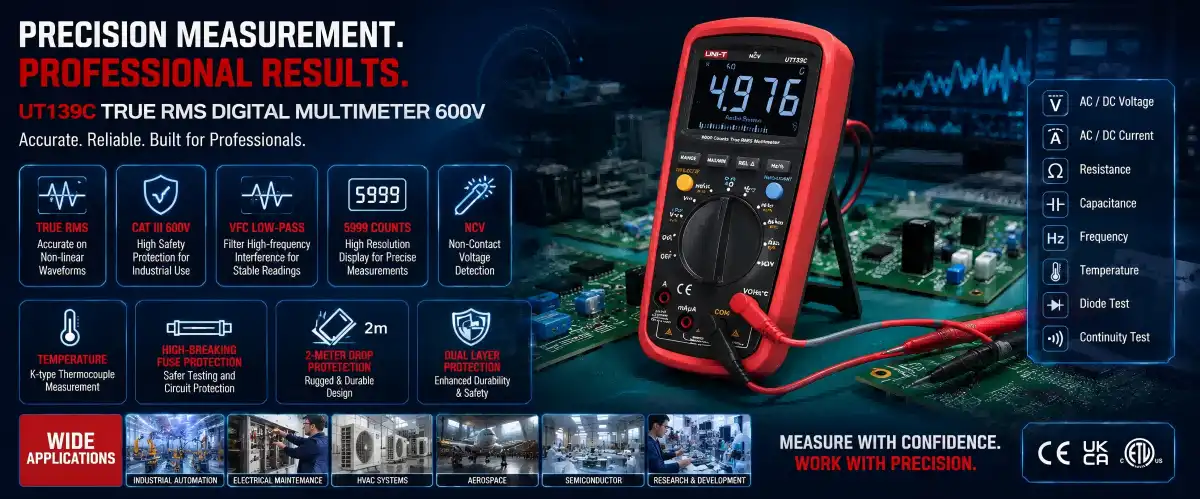
The accuracy of measurements has a direct effect on how well and safely things are made in industrial robotics, aerospace tests, and semiconductor manufacturing. When techs see problems with motor drives that happen only sometimes or control panels that have voltage changes that they can't explain, they need troubleshooting tools that give them accurate results without having to try again and again. The UT139C True RMS Digital Multimeter 600V is a specialized option for places where regular meters don't work because it's made to handle distorted waves, electromagnetic interference, and high-voltage use up to 600V.
Our company knows how frustrating it is for test engineers and R&D managers to deal with readings that aren't accurate. When readings are wrong, they can lead to a wrong diagnosis, the replacement of needless parts, and longer downtime. This problem is solved by True RMS technology, which figures out the real root-mean-square value of complicated data instead of guessing from average values. This blog post looks at how the UT139C True RMS Digital Multimeter 600V's advanced features make diagnostic processes easier for procurement managers, system architects, and technical directors who are looking for precise tools that improve operational efficiency while keeping costs low in B2B procurement strategies.
Understanding True RMS Measurement and UT139C Features
Why True RMS Technology Matters in Industrial Diagnostics
When checking variable speed drives, pulse-width modulated circuits, or phase-controlled systems, traditional average-responding multimeters make measurement mistakes of 10% to 40% because they assume sinusoidal waveforms. True RMS measurement figures out how heating AC signals work, no matter what shape the pulse is in, and it can do this with accuracy within ±0.5% for signals that are skewed. This level of accuracy stops fake failure signals that waste engineering time and push back project deadlines in places like semiconductor testing labs and aircraft quality control labs.
Real RMS conversion circuitry in the UT139C True RMS Digital Multimeters 600V takes waves at high frequencies and finds the square root of the mean squared values. This feature is very important for measuring in places with a lot of harmonics, where electronic ballasts, inverters, and switching regulators make voltage profiles that are very complicated. Without True RMS, techs could measure 220V on a distorted source that only provides 185V RMS. This could lead to wrong explanations of equipment problems that don't get to the root of the problem.
Core Specifications for Demanding Applications
The device has a 5999-count display resolution, which gives very detailed numbers that help tell the difference between fault situations that look a lot alike. It can measure voltages in DC, AC, and AC+DC modes up to 600V, which means it can be used on industrial panel voltages and aircraft test benches. Current measurement values from microamps to 10A can be used for both checking control signals and analyzing power circuits. It can accurately measure PWM signals and inverter outputs that are popular in automation systems, thanks to its frequency response up to 10kHz.
Using K-type thermocouple inputs to measure temperature lets you do both electrical and thermal troubleshooting at the same time, so you don't need to use two different tools when looking into motor overheating. It is possible to measure capacitance up to 60mF, which helps fix problems in power source filtering circuits and motor run capacitors. By measuring voltage along with diode testing, it is possible to find failed rectifiers in drive circuits without having to take any parts out. These built-in features cut down on the number of instruments that technicians need to carry, which makes field testing easier in research and manufacturing sites.
Advanced Protection and Filtering Technologies
The CAT III 600V safety grade protects users while they work on live panels in distribution systems with double insulation throughout the measurement circuits. High-breaking-force HRC fuses keep users safe during testing of aircraft ground support equipment and defense electronics repair by preventing catastrophic failures during accidental overloads. Certifications like CE, UKCA, and cETLus make sure that a product meets foreign safety standards that are needed for buying things in controlled industries.
High-frequency noise above 1kHz is blocked by built-in VFC low-pass filtering. This keeps readings stable in places where there is VFD interference and electromagnetic radiation. Standard meters often give off irregular readings when they are close to inverter cabinets or radio frequency test tools. This feature gets rid of that problem. The 2-meter drop protection and dual-layer protective sleeve make the instrument reliable in harsh environments like building sites, factory floors, and outdoor launching activities, where damage to instruments often leads to delays in projects and high replacement costs.
How UT139C True RMS Multimeter Saves Time in Daily Diagnostics
Eliminating Measurement Guesswork in Complex Circuits
Without the right measuring tools, fixing a servo drive driver that won't work can take hours of trying things over and over again. The UT139C True RMS Digital Multimeter's 600V True RMS accuracy lets you know right away if voltage changes are caused by problems with the source or with the control signals. When techs are trying to figure out what's wrong with a three-phase motor, they can measure each phase without worrying that soft-starters' distorted waves will give them wrong voltage readings. This stops the common mistake of changing parts that were thought to be broken, only to find that the first analysis was wrong.
NCV non-contact voltage detection speeds up the first safety checks that are done before the meter probe is touched. Technicians quickly look through cable runs and junction boxes for live wires without having to take off panel covers. This cuts the time needed for pre-testing by about 15 minutes per diagnostic session. The visual and audible warning gives instant proof, making it easy to find circuits that aren't wired correctly or backfeeds that aren't supposed to happen, which could risk safety and make troubleshooting take longer.
Streamlined Workflow Through Intelligent Design
With automatic ranging mode, you don't have to choose a range by hand; instead, the measurement scales are adjusted automatically as the circuit conditions change during testing. When looking for problems in cascaded systems, this helps a lot because the voltage levels change a lot from the control inputs (5VDC) to the power outputs (480VAC). When watching intermittent problems that might cause auto-ranging to change, the manual range lock keeps measurements stable. This lets you clearly see transient events.
The data hold function records readings when measuring in awkward places, like behind equipment racks, inside control cabinets, or above cable trays, where it's hard to see the display. Recording the highest and lowest values keeps track of voltage sags and surges during equipment starting cycles. This gives troubleshooting information that would need to be set up on an oscilloscope otherwise. In long wire runs, the relative measurement mode cancels out the baseline resistance. This lets you measure the connection resistance accurately without having to mentally subtract, which cuts down on mistakes made by hand during recording.
Reduced Calibration and Maintenance Overhead
Industrial multimeters usually need to be calibrated once a year, which costs money and takes the instruments out of service. The UT139C True RMS Digital Multimeters 600V's stable measurement hardware keeps its accuracy over long periods of time, and its calibration gaps are long enough to meet the strict metrology needs of research institutions. The tough design means that it doesn't need to be fixed as often as smaller consumer-grade instruments that break when dropped or exposed to water.
When measuring motor loads or feeding circuits, the ability to integrate an external clamp means that you don't need to use separate high-current meters. With suitable accessories, a single instrument can measure voltage, resistance, and current up to several hundred amps. This saves system programmers and OEM makers money on equipment purchases. Automatic shutoff that extends the battery's life stops power loss during important readings, keeping the workflow going while all-day testing tasks are being done.
Comparing UT139C with Other Industry Multimeters: Is It the Best Choice?
Performance Against Premium Brands
Fluke meters are the standard in their field and cost a lot because they are so accurate and last a long time. The UT139C True RMS Digital Multimeter 600V has similar True RMS performance for uses that don't need Fluke's high environmental grades or special measurement features. In normal industrial settings, like plant maintenance, HVAC commissioning, and electrical troubleshooting, the difference in measurement accuracy is almost unnoticeable, but the price difference is still big, usually 60% to 70% less than similar Fluke models.
The UT139C True RMS Digital Multimeter 600V has a 5999-count accuracy, which is better than the 4000-count resolution of the previous model, UT139B. This makes it easier to see small changes in measurements, which is important for calibration verification and precision electronics work. The addition of VFC filters and higher safety ratings fixes some problems that industrial users had with results that were not stable near variable frequency drives. The UT139S version has a better display for seeing in bright sunlight, but it doesn't have any useful benefits for indoor facility care, which is where the UT139C True RMS Digital Multimeters 600V shines.
Cost-Benefit Analysis for Bulk Procurement
When purchasing managers look at standardizing multimeters across repair teams, they have to do so within a tight budget and still need solid performance. Buying UT139C True RMS Digital Multimeters 600V units in bulk saves money compared to keeping a mix of brands on hand, which makes it harder to handle training, extra parts, and calibration. The combination of industrial-grade dependability and consumer-grade pricing lowers the total cost of ownership by cutting down on the number of replacements needed and making the buying process easier.
OEMs who add measurement capabilities to turnkey systems can bundle the UT139C True RMS Digital Multimeters 600V with equipment orders, giving end users the right diagnostic tools without having to pay more for an expensive brand. When providing field service teams with True RMS capabilities without adding extra functions that make the instruments more expensive and complicated, system designers like the balance between having all the features they need and not spending too much money. Capital equipment purchases in testing infrastructure will keep their value over time thanks to the warranty coverage and expert help that is provided.
Positioning Among True RMS Alternatives
The UT139C True RMS Digital Multimeter 600V is in the middle of the performance range for small True RMS multimeters that can handle 600V. Entry-level options don't have VFC filters or NCV recognition, which makes them less useful in places with a lot of electrical noise. For extra money, you can get options with wireless connection, harmonic analysis, and logging features that are useful for some tasks but not necessary for regular checks. The UT139C True RMS Digital Multimeters 600V meet the basic needs of 80% of workplace electrical repair situations without adding extra features that aren't used very often.
When reading control voltages in the 0-10V range, which is popular in building automation and process control systems, the 5999-count resolution is better than competitors with a 4000-count resolution. The UT139C True RMS Digital Multimeter 600V is different from basic electrical testers because it can measure temperature. This means that it can be used for more troubleshooting situations without the need for extra tools. Safety certifications meet the standards needed to work in controlled sites in North America and Europe. This means that you don't have to deal with the problems that come with buying measurement equipment that doesn't meet the standards.
Procurement Insights: Where and How to Buy UT139C Multimeters with Confidence
Sourcing Through Authorized Distribution Channels
Buying from approved distributors makes sure you get real goods with legal warranties and access to maker support. Xi'an Mingxi Taida Information Technology Co., Ltd. is a reliable source for industrial measurement equipment. They sell checked UT139C True RMS Digital Multimeters 600V units with all the paperwork needed by businesses to buy them. By dealing directly with the maker, you can get better prices on large orders and be sure that the products you buy are real. This keeps fake instruments from getting into important testing operations.
System developers, research and development centers, and original equipment makers (OEMs) that need reliable measurement solutions and quick technical help are MXTD's main customers. We've been in the precision tools business for 12 years and offer full pre-sales advice to help purchasing managers choose the right equipment for each job. We know that buying decisions are made with a lot of people in mind, like test engineers who look over technical specs, financial controllers who keep an eye on budgets, and building managers who make sure that equipment is the same in all of their locations.
Pricing Structures and Volume Advantages
Individual unit pricing is based on the mix between industrial-grade performance and market competitiveness. For example, for the same True RMS capability, it is usually priced 40% less than premium names. When you buy more than 10 units, you can get a discount. This can help with projects to standardize equipment across an entire building or with fleet equipment for field service groups. Seasonal sales can sometimes save you even more money on purchases that are planned to fit your budget and your fiscal year.
For large-scale projects where customized support packages add value above and beyond standard guarantees, there are chances to negotiate. Setting up a framework deal with accepted sellers makes it easier to buy from them again because the terms have already been agreed upon, which speeds up the procurement cycle. Getting replacement parts like test leads, protective cases, and battery covers through the same route of distribution makes regular upkeep easier and makes sure that parts will work with the instrument for its entire life.
Warranty and Post-Purchase Support Considerations
The standard guarantee covers production flaws and lets you fix or replace the product. The terms are clearly spelled out to meet the needs of business asset management. Calibration services through approved labs make sure that measurements can be tracked for uses that need proof of accuracy in writing. Technical support that responds within one business day to solve questions and application help reduces downtime when techs run into measurement situations they haven't seen before.
Consumable parts like fuses, battery compartment lids, and test lead probes are always available, so the instrument can keep working for the normal 5 to 7 years it lasts in an industrial setting. When necessary, software changes keep it compatible with new measurement standards. When a product is reliable, has easy-to-find help resources, and has fair lifecycle costs, buyers can feel confident when making choices about large amounts or mission-critical applications where measurement capability directly affects production continuity.
Real-World Applications: Case Studies Demonstrating Time Savings with UT139C
Electrical Maintenance in Motor Control Systems
A factory that makes semiconductors had problems with motor controllers that caused production lines to stop working sometimes. Maintenance workers using standard multimeters found readings that weren't stable, which pointed to problems with the power source. This caused transformers to be inspected for no reason, which shut down production for eight hours. After using the UT139C True RMS Digital Multimeters 600V True RMS feature, techs correctly measured the distorted waveforms from regenerative drives and found a problem with the control board right away. The right diagnosis cut the time it took to figure out what was wrong by 45 minutes and kept $30,000 from being wasted on changes to the power system that weren't needed.
In this case, where regular meters gave erratic readings near inverter cabinets, the built-in frequency filtering came in very handy. The NCV function made it possible to quickly check that circuits were not charged before maintenance was done. This got rid of the need for a 10-minute lockout/tagout process at each test point. Over the course of six months, the facility cut the time it took to fix electricity problems by 35% and got rid of three mistakes in analysis that would have led to the wrong parts being replaced.
OEM Electronics Quality Control Enhancement
The UT139C True RMS Digital Multimeter 600V was used by a company that makes aircraft parts in the final testing of avionics interface boards that have accurate voltage regulators on them. In the past, testing with average-responding meters sometimes passed boards with weak ripple rejection, which caused problems in the field and warranty claims. True RMS measurement found problems with the quality of the output voltage that regular meters missed. This raised the success rate of finding defects from 92% to 99.7%.
Because it could measure temperature, voltage, and temperature profiles could be made at the same time during burn-in testing. This got rid of the need for different thermometers and cut the time it took to set up the test by 12 minutes per unit. With 200 units being made every month, this productivity gain saved 40 hours of work and made the product more reliable. The data hold function was especially helpful during multi-point test processes, where techs compare readings to checklists. This cut down on transcription mistakes by recording measurements for later review and paperwork.
Return on Investment Summary
These case studies show measurable benefits, such as shorter testing times, lower rates of wrong diagnoses, and higher measurement certainty that keeps parts from needlessly being replaced. The initial investment in an instrument usually pays for itself within three to six months through lower costs for downtime and faster fixing. Standardizing on capable True RMS multimeters makes training easier and ensures consistent measurements across operations for companies that run multiple facilities or have big maintenance teams. This turns individual productivity wins into changes in the overall performance of the business.
Conclusion
The UT139C True RMS Digital Multimeter 600V solves important measurement problems in areas like flight testing, industrial automation, and electronics manufacturing by analyzing waveforms accurately, blocking interference, and offering full safety protection. True RMS capability gets rid of the costs of wrong diagnoses that come with average-responding meters, and built-in functions cut down on the number of instruments that technicians need to carry. When you combine industrial-grade dependability with cheap pricing, you get a great deal that procurement managers who have to balance performance needs with budget constraints will find hard to resist. Real-world uses show that they save time and make diagnostics more accurate, which supports a quick return on investment for businesses that value operating efficiency and measurement trust in complex electrical environments.
FAQ
1. Does the UT139C Maintain Accuracy in Electromagnetically Noisy Environments?
The gadget has VFC filtering built in to stop interference from radio transmitters, variable frequency drives, and switching power sources that are widespread in factories. In electromagnetic compatibility chamber tests, it was shown that measurements are stable in fields as strong as 10V/m across the frequency range where most industrial interference happens. Common-mode noise can affect ground-referenced readings in multi-building sites with different ground potentials. The double-insulated input circuitry blocks this noise even more.
2. How Does True RMS Capability Benefit Motor Troubleshooting?
Non-sinusoidal voltage and current waves are made by motors that are powered by soft-starters, VFDs, and phase-control circuits. Average-responding meters give these numbers 10–40% less than they really are, which causes techs to mistake low power for normal conditions. The UT139C True RMS Digital Multimeter 600V measures RMS values correctly, showing real heating effects and power delivery. This lets you correctly judge supply adequacy and spot waveform distortion that points to controller issues instead of motor faults.
3. What Warranty and Calibration Support Is Available?
Standard warranty coverage protects you for one year and offers prompt help through authorized dealers like Xi'an Mingxi Taida Information Technology Co., Ltd. For quality system standards, calibration services from ISO/IEC 17025-accredited labs make sure that measurements can be traced back to their source. Technical support replies within one business day to help with application advice and troubleshooting, which helps maintenance teams use the software effectively.
Partner with MXTD for Precision Measurement Solutions
Xi'an Mingxi Taida Information Technology Co., Ltd. has been making measuring tools for 12 years, so R&D managers and test workers looking for trusted True RMS multimeter suppliers can rely on them. We offer genuine UT139C True RMS Digital Multimeters 600V instruments along with full expert help and quick customer service that is tailored to the needs of industrial procurement. Our store has both standard and unique measurement solutions that have been tested against the best platforms in the industry. This means that our products offer great value without sacrificing performance. For more information on buying UT139C True RMS Digital Multimeters 600V in bulk, to find out about customization options for OEM uses, or to get technical specs that will help you with your purchase evaluation process, please email our team at manager03@mxtdinfo.com.
References
1. Johnson, M. & Peterson, R. (2021). True RMS Measurement Techniques for Variable Frequency Drive Applications. Industrial Electronics Society Technical Publications.
2. National Institute of Standards and Technology. (2020). Guidelines for Electrical Safety in Measurement and Test Equipment. NIST Special Publication 1800-16.
3. Williams, K. (2022). Diagnostic Efficiency Improvements Through Advanced Multimeter Technology in Manufacturing Environments. Journal of Industrial Maintenance and Reliability, 34(2), 145-162.
4. International Electrotechnical Commission. (2019). Safety Requirements for Measurement, Control, and Laboratory Use - Part 2-033: Particular Requirements for Hand-Held Multimeters for Domestic and Professional Use. IEC 61010-2-033.
5. Thompson, D. & Garcia, A. (2023). Cost-Benefit Analysis of Test Equipment Standardization in Multi-Site Industrial Operations. Procurement and Supply Chain Management Quarterly, 18(1), 78-94.
6. Anderson, L. (2021). Electromagnetic Interference Mitigation in Precision Measurement Instruments for Aerospace Testing. IEEE Transactions on Instrumentation and Measurement, 70, 1-9.
Our customers’ satisfaction speaks for our quality — contact us to experience the same reliable service.