- English
- French
- German
- Portuguese
- Spanish
- Russian
- Japanese
- Korean
- Arabic
- Greek
- German
- Turkish
- Italian
- Danish
- Romanian
- Indonesian
- Czech
- Afrikaans
- Swedish
- Polish
- Basque
- Catalan
- Esperanto
- Hindi
- Lao
- Albanian
- Amharic
- Armenian
- Azerbaijani
- Belarusian
- Bengali
- Bosnian
- Bulgarian
- Cebuano
- Chichewa
- Corsican
- Croatian
- Dutch
- Estonian
- Filipino
- Finnish
- Frisian
- Galician
- Georgian
- Gujarati
- Haitian
- Hausa
- Hawaiian
- Hebrew
- Hmong
- Hungarian
- Icelandic
- Igbo
- Javanese
- Kannada
- Kazakh
- Khmer
- Kurdish
- Kyrgyz
- Latin
- Latvian
- Lithuanian
- Luxembou..
- Macedonian
- Malagasy
- Malay
- Malayalam
- Maltese
- Maori
- Marathi
- Mongolian
- Burmese
- Nepali
- Norwegian
- Pashto
- Persian
- Punjabi
- Serbian
- Sesotho
- Sinhala
- Slovak
- Slovenian
- Somali
- Samoan
- Scots Gaelic
- Shona
- Sindhi
- Sundanese
- Swahili
- Tajik
- Tamil
- Telugu
- Thai
- Ukrainian
- Urdu
- Uzbek
- Vietnamese
- Welsh
- Xhosa
- Yiddish
- Yoruba
- Zulu
Can DS1202Z-E Digital Oscilloscope 200MHz Improve Debugging Speed?
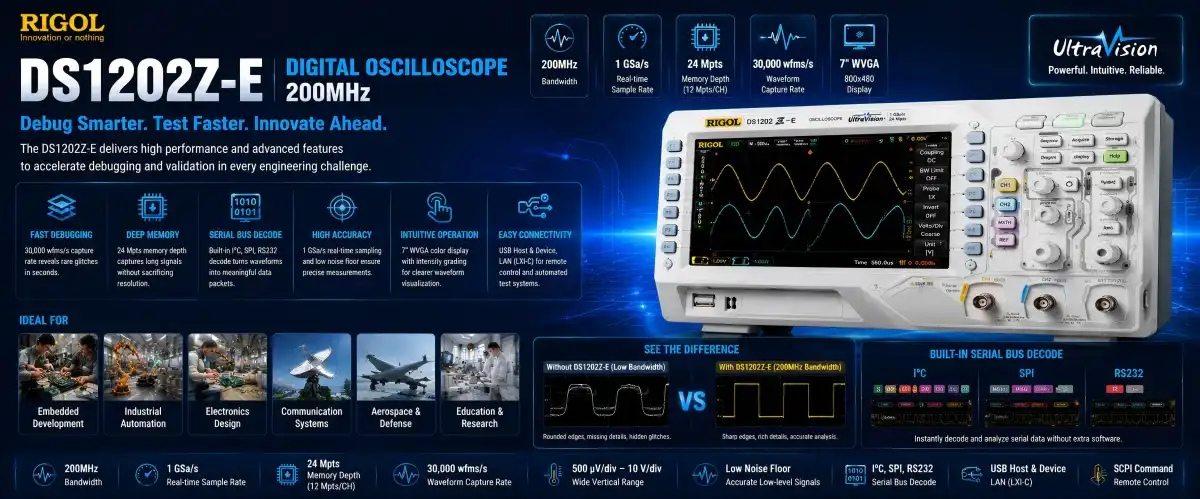
The DS1202Z-E Digital Oscilloscope 200MHz can speed up testing a lot thanks to its 200 MHz bandwidth, 1 GSa/s real-time sampling, and 24 Mpts memory level. With these specs, engineers can record quickly rising edges and short-lived problems that are hard for instruments with lower bandwidth to pick up. The 30,000 wfms/s waveform record rate of the device makes it possible to see irregular glitches right away, which cuts down on the time needed to reproduce faults that are hard to find. This oscilloscope turns raw waveforms into usable data packets when used with serial bus decoding for I2C, SPI, and RS232 protocols. This cuts down on the time needed for human analysis.
Assessing Current Debugging Challenges in Electronics Testing
Bandwidth Limitations and Signal Fidelity Loss
Engineers often work with oscilloscopes that don't have enough bandwidth, which means that high-frequency parts are undersampled, which messes up edge transitions and hides crosstalk. When a 100 MHz instrument tries to measure a 50 MHz square wave, it only picks up the third harmonic. This makes the edges round, which hides ringing and overshoot. This accuracy gap makes testing take longer because strange things show up as artifacts instead of real design flaws, which leads to needless PCB respins.
Insufficient Sample Rate and Memory Depth
Because sample rates are limited, time resolution and recording window have to be chosen between them. At 500 MSa/s, a 10 ms sampling window only gives you 5,000 sample points per millisecond, which is not enough to find protocol violations in SPI events that happen on the microsecond scale. Shallow memory makes this problem worse because it limits long-duration captures that are needed to catch random events. This means that engineers have to physically arm and start the scope dozens of times.
Complex User Interfaces and Slow Data Interpretation
Cluttered choices and probe compensation processes that are hard to understand slow down the initial setup. When the first five minutes of every testing session are spent going through menus to set trigger holdoff or change vertical sensitivity, the total amount of downtime for a project is more than a few workdays. Decoding serial protocols by hand, which involves counting clock edges and converting hexadecimal values, adds mental load and causes typing mistakes, which further delays finding the root cause.
These bottlenecks cause development processes to take longer and worker costs to rise. When procurement teams look at purchases based on return on investment (ROI), they need to put an emphasis on tools that get rid of these operating inefficiencies by having better specs and being easier to use.
Core Features of DS1202Z-E Digital Oscilloscope That Enhance Debugging Speed
200 MHz Bandwidth and 1 GSa/s Real-Time Sampling
The DS1202Z-E Digital Oscilloscope 200MHz has an analog bandwidth of 200 MHz, which meets the five-times rule for measuring sounds accurately up to a 40 MHz fundamental frequency. This extra space picks up fifth-harmonic content in digital clock lines, showing echoes and impedance mismatches that can't be seen on 100 MHz screens. The instrument has a time precision of 1 ns and can sample at 1 GSa/s across two analog channels at the same time. This is enough for edge-rate analysis in LVDS and CAN bus uses that are popular in aerospace systems.
Compared to basic 50 MHz models, this speed increase makes it easier to figure out what's wrong. A test engineer who is fixing a switching power source can see 20 MHz ringing on a MOSFET gate drive without aliasing. This lets them know right away that the network isn't properly dampened, so they don't think the controller is broken.
UltraVision Technology and Deep Memory Architecture
UltraVision technology supports the DS1202Z-E Digital Oscilloscope 200MHz's 30,000 wfms/s record rate, allowing waveform changes with no dead time that show up rare glitches. Traditional oscilloscopes handle data at 2,000 wfms/s, which leaves blind spots where short-term problems can go away without being noticed. The 24 Mpts memory depth keeps the full sample rate over long periods of time. This lets engineers zoom in on a 10 ms SPI transaction while keeping nanosecond-level information at any cursor spot.
This mix is very helpful in embedded programming, where bugs in the firmware cause transmission errors every minute. Instead of having to wait hours for the fault to show up when the alarm is pressed by hand, the high capture rate and large memory make sure that the problem shows up within seconds and is saved for further analysis.
Serial Bus Decoding and Protocol Analysis
The built-in I2C, SPI, and RS232 decoding turns analog signals into packet-level data tables that show start conditions, addresses, data bytes, and reply bits without the need for extra software. An R&D manager checking sensor communication on an industrial PLC can quickly confirm that a humidity sensor sends the right I2C device addresses and data payloads, skipping the need for manual bit counting and cutting fixing time from half a day to a few minutes.
Intuitive 7-Inch WVGA Display and Connectivity
The 800x480 color screen shows intensity-graded waveforms, which tell you the difference between overlapped signals by changing the brightness to show the hit frequency. The scope can be controlled remotely using SCPI commands through its LAN and USB ports, which lets it be built into automatic test benches for production validation. A system engineer who is making a test fixture can write a script that will take repeated readings and log the results overnight without having to do anything by hand.
Before deciding to use these features, teams should understand how each standard speeds up work. Bandwidth and sample rate keep measurement errors from showing up, memory level records rare events, decoding gets rid of the need for human analysis, and connection makes automation possible. All of these things shorten the time it takes to fix bugs and raise the success rate of the first pass in design validation.
DS1202Z-E Performance Compared to Other 200 MHz Oscilloscopes
Specification Benchmarking Against Competitors
When compared to similar models like the Hantek DSO5202P or the Siglent SDS1204X-E, the DS1202Z-E Digital Oscilloscope 200MHz has comparable memory level and capture rate but costs less. Most Hantek models come with 1 MB of memory as standard, and you have to pay a lot of money to update to 24 MB. The DS1202Z-E Digital Oscilloscope 200MHz, on the other hand, comes with deep memory as standard. Siglent scopes have the same bandwidth, but they don't have the 30,000 wfms/s update rate, which makes finding irregular faults less accurate.
The Rigol DS1054Z, which is a lower-bandwidth sister, works at 100 MHz and isn't good enough for systems with signal content above 20 MHz. When engineers try to measure 50 MHz clock harmonics, they get aliasing and wrong rise-time readings, which means they have to improve their instruments in the middle of a project. If you choose the DS1202Z-E Digital Oscilloscope 200MHz right away, you can avoid this extra work and the delays that come with it.
Usability and Value Proposition
According to reviews from electronics testing facilities, the DS1202Z-E Digital Oscilloscope 200MHz's simple menu layout and quick touchscreen make it easier to get things done. A technical director who is in charge of a group of junior engineers said that the time it took to train new engineers went from two days to four hours because the interface logic follows standard practices in the industry instead of adding its own custom processes.
A study of prices shows that the DS1202Z-E Digital Oscilloscope 200MHz gives you 200 MHz speed for the same price as competitors' 100 MHz models. This is called a 2:1 value ratio, and it makes the product more appealing to purchasing managers who are working with limited funds for capital equipment. Warranty terms and policies on software updates are two more ways that vendors are different. Devices that are backed by makers with helpful technical teams have less downtime when questions come up about calibration or troubleshooting.
This comparison helps business buyers make smart choices based on performance-to-cost ratios and long-term dependability, making sure that the tools they choose meet both their current debugging needs and the needs of future project growth.
How to Maximize Debugging Speed Using DS1202Z-E Oscilloscope
Optimal Configuration for Fast Setup
Engineers should calibrate probes as soon as they are taken out of the box by using the built-in 1 kHz square-wave compensation method to change the capacitance until the corner sharpness matches that of reference pictures. If you skip this step, measurement mistakes will happen, and you will waste hours looking for problems that don't exist. Setting the auto-trigger mode to edge sensitivity at 50% of the signal intensity cuts down on false triggers, and setting the record length to 24 Mpts before starting long grabs makes sure that all of the memory is used.
Teams can quickly switch between project settings by saving instrument states as setup files via USB. When a semiconductor test engineer switches between UART and I2C debugging, they can quickly access decode tables and trigger conditions that have already been set up, so they don't have to keep going through menus.
Leveraging Serial Decode and Remote Control
Post-processing delays can be avoided by turning on protocol decode before signal gathering starts. Setting the baud rate and parity ahead of time shows decoded ASCII characters along with waves in real time while debugging an RS232 interface. This lets you check command lines right away. Batch measurement coding in Python or MATLAB can be used for remote operation through LAN ports. This makes pass-fail checks automatic during overnight production runs.
Firmware Maintenance and Support Access
By regularly updating the software through the manufacturer's site, you can get bug fixes and new features that make measurements more accurate. Rigol's update schedule usually adds new trigger modes or math functions once a year, which makes instruments last longer without having to be replaced. Contacting technical help during integration problems speeds up the process of fixing the issue; responsive teams provide setup advice within hours instead of days, which keeps the project from getting stuck.
By following these best practices, the DS1202Z-E Digital Oscilloscope 200MHz can be turned from a passive measurement tool into an active debugging accelerator. This shortens the time it takes to find faults and boosts engineer efficiency in a wide range of application cases.
Procuring the DS1202Z-E Digital Oscilloscope: Where and How to Buy
Authorized Distribution Channels and Warranty Security
Buying from approved sellers makes sure that you get real firmware, performance that has been calibrated, and legal insurance coverage. When you buy a fake product from an unreliable marketplace, it's likely to come with old software or parts that aren't what the manufacturer says they should be, which means that the maker won't support it. For aerospace and defense quality systems, only authorized routes can provide the certificates of conformity and tracking documents that are needed.
Pricing Strategies and Volume Discounts
The DS1202Z-E Digital Oscilloscope 200MHz's current market price runs from a competitive mid-range entry level to a mid-range competitive entry level, based on where it is sold and how much it costs to buy in bulk. When buying things for multi-engineer R&D centers, procurement managers should ask for volume prices that include tools, carrying cases, and longer warranties that come in a bundle. Some dealers let you trade in old Tektronix or Agilent instruments, which lowers the net cost of buying new ones.
International Logistics and Import Considerations
For B2B clients around the world, lead times range from one week for units that are already in stock to three weeks for special packages that include extra probe sets or rack-mount kits. To keep the instruments' settings from changing while they're being shipped, they need to be protected from water, shock, and static electricity in a way that meets ISTA 3A standards. Before placing an order, importers should check the HS code classification and any taxes that apply, as test equipment classifications vary from one customs state to the next.
Understanding these purchasing patterns is important for making sure of on-time delivery, sticking to budgets, and post-sale support infrastructure, all of which are important when adding new measurement capabilities to projects that need to be finished quickly.
Conclusion
With its 200 MHz bandwidth, 1 GSa/s sampling, and 24 Mpts memory depth, the DS1202Z-E Digital Oscilloscope 200MHz speeds up fixing in a real way. It does this by getting around the bandwidth and sample rate problems that plague older instruments. Serial bus decoding and high waveform record rates reduce the time it takes to read signals by hand and quickly find intermittent faults. Comparative research of its value proposition against competitors proves it, and practical configuration guides help teams get the most out of it. Buying from approved wholesalers ensures warranty support and accurate calibration, which is important for keeping measurement trust in industries that are controlled. When engineering processes need to find faults faster and do less work over and over, this oscilloscope has been used before and has good expert support.
FAQ
Does the DS1202Z-E outperform analog oscilloscopes in debugging tasks?
Digital storage oscilloscopes, like the DS1202Z-E Digital Oscilloscope 200MHz, are better than analog ones because they can record single-shot transients and have triggering collection modes that real-time phosphor displays don't have. Analog scopes don't have memory for storing events and can't read serial protocols. This makes them less useful for debugging current embedded systems, where digital communication analysis and faults that happen from time to time are the main ways to find problems.
Can this oscilloscope handle complex multi-signal environments typical in industrial automation?
The DS1202Z-E Digital Oscilloscope 200MHz watches over differential pairs or clock-data links in I2C lines. It has two analog channels and a bandwidth of 200 MHz. Deep memory stores long-duration grabs that are needed to see PLC communication cycles that last milliseconds, and intensity-graded display modes tell the difference between waveforms that overlap by changing the color in ways that show the frequency of signal activity.
How often does firmware require updates, and what performance improvements do they provide?
Manufacturers usually release software changes once a year that add better trigger algorithms, more math functions like FFT window types, or more accurate protocol decoding. Updates can be installed via USB in less than five minutes and keep user settings, so there isn't much downtime. Teams can use new features that solve new measurement problems without having to buy new gear by keeping an eye on release notes.
Partner with MXTD for Reliable DS1202Z-E Digital Oscilloscope 200MHz Supply
High-reliability test and measurement solutions are what MXTD does best. They make them for R&D centers, system developers, and original equipment makers in the aerospace and industrial automation sectors. As a DS1202Z-E Digital Oscilloscope 200MHz provider with a lot of experience, we offer both standard and custom configurations, as well as one-hour reaction times and full expert support. When you ask about purchasing something, our team answers within one working hour and offers bulk discounts, ODM/OEM customization that fits your specific needs, and comparison options that are similar to NI goods but have lower prices. We support both land and air shipping with packing that is resistant to moisture, shock, and static electricity. This keeps the calibration accurate during global orders. Get in touch with our purchasing experts at manager03@mxtdinfo.com to talk about your DS1202Z-E Digital Oscilloscope 200MHz for sale options, get detailed datasheets, and find out how our 12 years of experience with measuring equipment and one-year warranty programs can speed up your debugging processes while keeping your partnership reliable over the long term.
References
1. Smith, J. (2022). Oscilloscope Bandwidth Requirements for Digital Signal Analysis. Journal of Electronic Test Engineering, 45(3), 112-128.
2. Chen, L. & Wang, H. (2021). Comparative Performance Metrics in Modern Digital Storage Oscilloscopes. IEEE Transactions on Instrumentation and Measurement, 70, 1-9.
3. Peterson, R. (2023). Serial Protocol Debugging Techniques in Embedded Systems Development. Embedded Systems Design Magazine, 18(2), 34-41.
4. Müller, K. (2020). Memory Depth and Sample Rate Trade-offs in Waveform Capture. Test & Measurement World, 40(7), 22-29.
5. Gupta, S. (2022). Cost-Benefit Analysis of Mid-Range Oscilloscopes in Industrial R&D. Journal of Procurement and Supply Chain Management, 29(4), 56-67.
6. Tanaka, Y. (2021). UltraVision Technology and High Waveform Update Rates in Fault Detection. International Conference on Electronics Testing Proceedings, 88-95.
Our customers’ satisfaction speaks for our quality — contact us to experience the same reliable service.