- English
- French
- German
- Portuguese
- Spanish
- Russian
- Japanese
- Korean
- Arabic
- Greek
- German
- Turkish
- Italian
- Danish
- Romanian
- Indonesian
- Czech
- Afrikaans
- Swedish
- Polish
- Basque
- Catalan
- Esperanto
- Hindi
- Lao
- Albanian
- Amharic
- Armenian
- Azerbaijani
- Belarusian
- Bengali
- Bosnian
- Bulgarian
- Cebuano
- Chichewa
- Corsican
- Croatian
- Dutch
- Estonian
- Filipino
- Finnish
- Frisian
- Galician
- Georgian
- Gujarati
- Haitian
- Hausa
- Hawaiian
- Hebrew
- Hmong
- Hungarian
- Icelandic
- Igbo
- Javanese
- Kannada
- Kazakh
- Khmer
- Kurdish
- Kyrgyz
- Latin
- Latvian
- Lithuanian
- Luxembou..
- Macedonian
- Malagasy
- Malay
- Malayalam
- Maltese
- Maori
- Marathi
- Mongolian
- Burmese
- Nepali
- Norwegian
- Pashto
- Persian
- Punjabi
- Serbian
- Sesotho
- Sinhala
- Slovak
- Slovenian
- Somali
- Samoan
- Scots Gaelic
- Shona
- Sindhi
- Sundanese
- Swahili
- Tajik
- Tamil
- Telugu
- Thai
- Ukrainian
- Urdu
- Uzbek
- Vietnamese
- Welsh
- Xhosa
- Yiddish
- Yoruba
- Zulu
Multi-functional Data Acquisition and Signal Conditioning
2.Analog Input Resolution (bits):16
3. Analog Input Sampling Rate (S/s):2M
4.Analog Input Scan Rate (S/s):1M
5.Analog Input Range:±10V, ±5V, ±2V, ±1V, ±0.5V, ±0.2V, ±0.1V
6.Analog Input Impedance:>1GΩ
7.Analog Input Coupling Mode:DC, Ground
8.Acquisition Trigger Modes:Software Trigger, Digital Trigger, Analog Trigger
9.Analog Input Buffer:8 MB
Multi-functional Data Acquisition and Signal Conditioning-
Data acquisition and signal conditioning serve as the bridge connecting the physical world and the digital world. Their main function is to convert the physical signals in the real world into digital signals that can be accurately recognized, processed and stored by computers.
Specifications
| Item | PXI |
|---|---|
| Number of Analog Input Channels | 32SE/16DI |
| Analog Input Resolution (bits) | 16 |
| Analog Input Sampling Rate (S/s) | 2M |
| Analog Input Scan Rate (S/s) | 1M |
| Analog Input Range | ±10V, ±5V, ±2V, ±1V, ±0.5V, ±0.2V, ±0.1V |
| Analog Input Impedance | >1GΩ |
| Analog Input Coupling Mode | DC, Ground |
| Analog Input DC Accuracy | ≤0.1% FS |
| Acquisition Trigger Modes | Software Trigger, Digital Trigger, Analog Trigger |
| Acquisition Modes | Continuous Acquisition Mode, Finite Point Acquisition Mode |
| Analog Input Buffer | 8 MB |
| Number of Analog Output Channels | 4 |
| Analog Output Resolution (bits) | 16 |
| Analog Output Update Rate (S/s) | 1.25M |
| Analog Output Range | ±10V, ±5V, APF<0..1> |
| Analog Output Modes | Aperiodic Waveform, Periodic Waveform, Non-Periodic Waveform |
| Number of Digital I/O Channels | 48 |
| Digital I/O Level | 5V TTL/CMOS |
| Digital I/O Sampling/Update Rate (S/s) | 10M |
| Number of Counters | 2 |
| Counter Bits | 32 |
| Internal Timing/Counting Reference | 20MHz ± 0.1MHz |
| Interface Type | Dual-layer 68-pin VHDCI + Female |
| Operating Temperature | -20°C ~ +50°C |
| Storage Temperature | -40°C ~ +70°C |
| Operating Humidity | 10% ~ 90%, non-condensing |
| Storage Humidity | 5% ~ 95%, non-condensing |
| Dimensions | PXI single-slot 3U standard module |
Typical application scenarios
- Product development and verification:
- Automobile: Engine bench test (simultaneously measuring fuel consumption, emissions, temperature, pressure, and torque), NVH (noise, vibration, and acoustic roughness) analysis.
- Aerospace: Aircraft structural health monitoring, wind tunnel testing.
- Consumer electronics: Drop test for mobile phones, analysis of battery charging and discharging characteristics.
- Industrial Automation and Testing:
- Production line product testing: Conduct rapid tests to determine whether the product functions are in compliance (such as circuit board testing).
- Equipment condition monitoring and predictive maintenance: Continuously monitor the vibration and temperature of critical equipment in the factory to predict malfunctions.
- Scientific research:
- Physics/Chemistry Experiment: Collect data from various sensors during the experiment process.
- Biomedical Engineering: Collection and analysis of physiological signals such as electrocardiogram and electroencephalogram.
- Environmental and Facility Monitoring:
- Long-term monitoring of building structural health, data collection at meteorological stations, and power quality monitoring.
Functionality
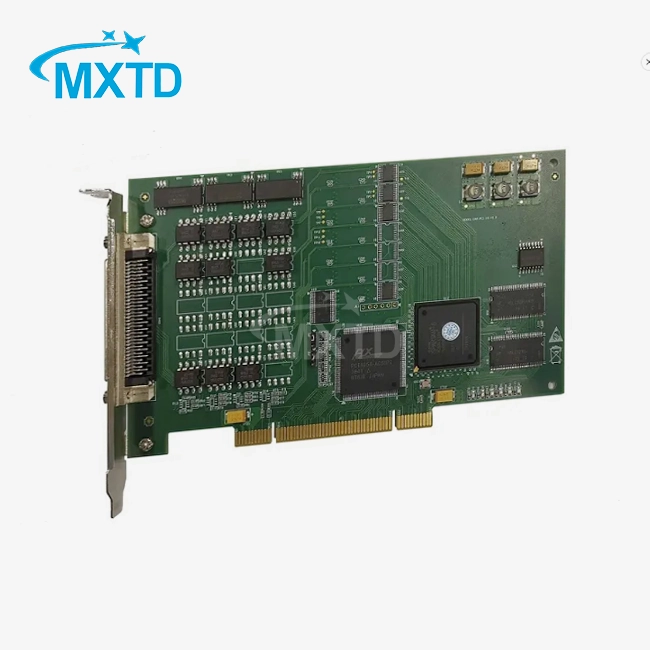
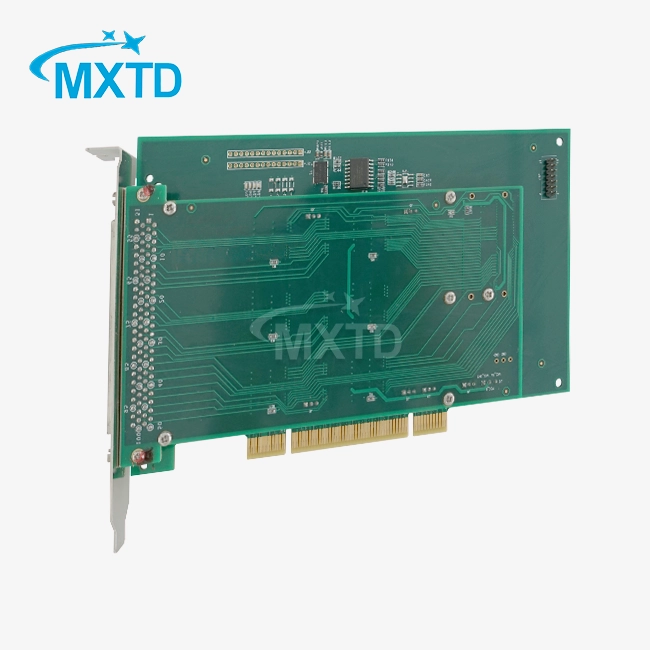
The multi-functional data acquisition card features up to 64 analog input channels with 16-bit resolution, a maximum single-channel sampling rate of 2 MS/s, and a maximum multi-channel scanning rate of 1 MS/s. It also provides up to 4 analog output channels with 16-bit resolution, 48 digital I/O channels, and two 32-bit timers/counters. Equipped with a large onboard buffer of up to 64 MB, it significantly enhances input/output data buffering capability, effectively reducing the response speed requirements for the host computer. This series of products employs a programmable instrument gain amplifier and a system timing controller, which notably improve measurement accuracy across the entire range. Furthermore, the high density of analog and digital channels helps effectively reduce the cost of building test systems for users. The multi-functional data acquisition card is primarily used for measurement and simulation of electrical and non-electrical quantities; timing analysis and simulation, bus testing and simulation; as well as period, frequency, pulse width measurement, edge counting, pulse output, and more.
Key Features
-
Integrates six functions—AI/AO/DI/DO/CI/CO—supporting parallel operation, offering high cost-effectiveness, reducing system complexity, and improving testing efficiency.
-
Features up to 64 MB of onboard buffer, reducing bus transmission pressure and lowering configuration requirements for the host computer.
-
Supports up to 64 analog input channels with a maximum scan rate of 1 MS/s, meeting the demands of large-scale multi-channel system testing.
-
Offers seven analog input ranges from ±100 mV to ±10 V, enabling high-precision testing across a broader spectrum.
-
Provides analog output with a maximum update rate of 2 MS/s, suitable for generating complex simulation signals or excitation signals.
-
Includes up to 48 digital I/O channels with a maximum sampling/update rate of 20 MHz, meeting the needs of high-speed timing analysis and high-precision timing signal output.
-
Equipped with two 32-bit universal counters with a maximum clock reference of 80 MHz, fulfilling high-precision requirements for period, frequency, pulse width, and other measurements.
-
Fully localized resources including Chinese programming manuals, development documentation, software interfaces, and example programs, tailored to the usage habits of domestic users.
-
Built with industrial-grade components for enhanced environmental adaptability and higher reliability.
Custom Design
The design of the data acquisition and signal conditioning system is not a random combination, but is based on a series of strict engineering principles, standards and actual requirements.
1. Measurement requirements and performance indicators (the fundamental starting point)
2. Characteristics of Sensors and Signal Sources (Design Input Conditions)
3. Industry Standards and National Regulations (Compliance Assurance)
4. System Architecture and Key Technology Selection (Implementation Methods)
5. Reliability, maintainability and cost (engineering considerations)

Why Choose MXTD?
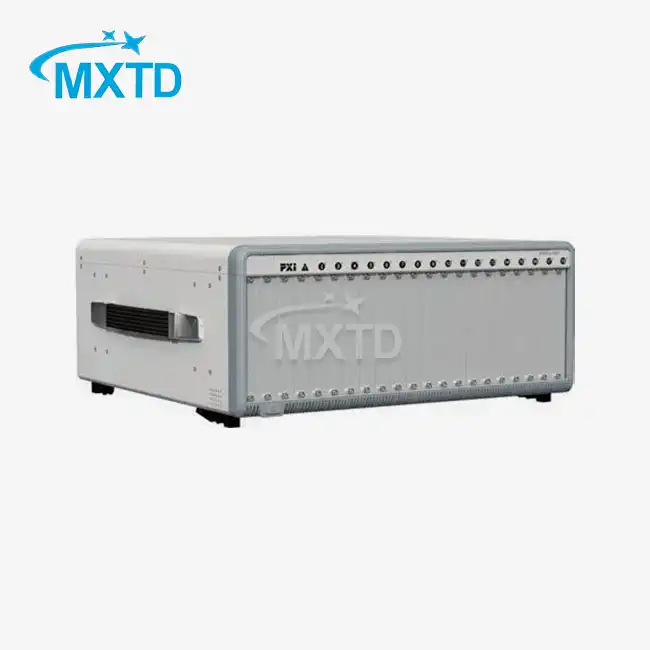
With over 12 years of industry experience, Xi'an Mingxi Taida brings deep expertise in modular test and measurement solutions. Our commitment to quality drives continuous innovation in PXIe chassis design, ensuring you get a product that’s built to last.
Expert Engineering: Our R&D team specializes in high-speed backplane design and synchronization, delivering solutions that meet the most demanding technical requirements.
Comprehensive Support: From initial consultation to deployment and maintenance, we provide end-to-end project support.
Quality Manufacturing: Advanced production processes and strict quality control ensure consistent reliability in every unit.
Flexible Solutions: Whether you need a standard 8-slot chassis or a fully custom multi-chassis system, we adapt to your needs.
Reliable Logistics: Partnered shipping ensures secure, tracked delivery with full insurance coverage for your peace of mind.


FAQ
Q: How many sensors can be connected at most?
A: Supports up to 64 analog input channels, accommodating 64 sensors (single-ended mode) or 32 differential sensors.
Q: Does it support analog output?
A: Yes, up to 4 analog output channels with a maximum update rate of 2 MS/s.
Q: Does it have counter functions?
A: Yes, two 32-bit counters with a clock reference up to 80 MHz, capable of measuring frequency, pulse width, etc.
Q: Is programming complex? Are examples provided?
A:Complete Chinese manuals, examples, and graphical software are provided for easy onboarding.
Q: How is data transmitted to the computer?
A: High-speed transmission via PCIe/PXI bus ensures real-time performance.

Contact Us
The data acquisition and signal conditioning system is essentially a "standardized pipeline for industrial data" - it transforms the chaotic real-world signals into "standard digital food" that can be digested and analyzed by intelligent systems. In the context of Industry 4.0 and intelligent manufacturing, this is no longer just a technical choice but an infrastructure investment for data-driven decision-making.
Email: manager02@mxtdinfo.com
Contact us today to discover how our industrial computing solutions can enhance your project's success.
Our customers’ satisfaction speaks for our quality — contact us to experience the same reliable service.