- English
- French
- German
- Portuguese
- Spanish
- Russian
- Japanese
- Korean
- Arabic
- Greek
- German
- Turkish
- Italian
- Danish
- Romanian
- Indonesian
- Czech
- Afrikaans
- Swedish
- Polish
- Basque
- Catalan
- Esperanto
- Hindi
- Lao
- Albanian
- Amharic
- Armenian
- Azerbaijani
- Belarusian
- Bengali
- Bosnian
- Bulgarian
- Cebuano
- Chichewa
- Corsican
- Croatian
- Dutch
- Estonian
- Filipino
- Finnish
- Frisian
- Galician
- Georgian
- Gujarati
- Haitian
- Hausa
- Hawaiian
- Hebrew
- Hmong
- Hungarian
- Icelandic
- Igbo
- Javanese
- Kannada
- Kazakh
- Khmer
- Kurdish
- Kyrgyz
- Latin
- Latvian
- Lithuanian
- Luxembou..
- Macedonian
- Malagasy
- Malay
- Malayalam
- Maltese
- Maori
- Marathi
- Mongolian
- Burmese
- Nepali
- Norwegian
- Pashto
- Persian
- Punjabi
- Serbian
- Sesotho
- Sinhala
- Slovak
- Slovenian
- Somali
- Samoan
- Scots Gaelic
- Shona
- Sindhi
- Sundanese
- Swahili
- Tajik
- Tamil
- Telugu
- Thai
- Ukrainian
- Urdu
- Uzbek
- Vietnamese
- Welsh
- Xhosa
- Yiddish
- Yoruba
- Zulu
NI-9263 C Series Voltage AO Module
2. Synchronous update architecture
3. Stable accuracy: Gain error ±0.01%, offset error ±0.5 mV, update rate up to 50 kS/s/ch (all channels synchronized)
4. Comprehensive software support: NI-DAQmx driver covers LabVIEW/Python/C/C++/.NET, supporting both software and hardware timing modes
The NI-9263 is a high-performance C-series analog voltage output module from National Instruments, designed specifically for the CompactDAQ and CompactRIO platforms.
This NI-9263 C Series Voltage AO Module provides 4 channels of synchronously updated analog output, 16-bit resolution, ±10 V output range, a maximum update rate of 100 kS/s per channel, and integrates 250 Vrms dual isolation to ground, ±30 V overvoltage protection, and indefinite short-circuit protection.
Under calibrated typical conditions (25 °C, ±5 °C), the NI-9263 exhibits a gain error of only 0.03%, a bias error of only 0.1%, a gain drift of 11 ppm/°C, and a bias drift of 110 μV/°C, ensuring stable and accurate voltage output over a wide temperature range from -40 °C to 70 °C. The module boasts a MTBF of 1,732,619 hours (25 °C, Bellcore standard), demonstrating exceptional long-term reliability.
MXTD Supplier
MXTD is a premier, forward-thinking technology enterprise specializing in the seamless integration of product research and development, global sales, and comprehensive customer support. Backed by over a decade of deep industry expertise in R&D and manufacturing, we deliver cutting-edge solutions tailored to the evolving needs of our international clientele.
Our robust footprint extends across key global markets, including North America, South America, Europe, and Africa. In addition to our proprietary innovations, we proudly serve as a trusted distributor for major international brands, offering a versatile product portfolio that satisfies diverse consumer demands. Driven by an uncompromising commitment to quality, we enforce rigorous, detail-oriented inspection standards at every stage. This guarantees that every partner who chooses MXTD experiences unmatched product reliability, performance, and long-term peace of mind.
Description
The NI-9263 is an analog voltage output module in the NI C series module family, primarily designed to provide high-precision, synchronously updated analog voltage signal generation capabilities for CompactDAQ and CompactRIO systems.
As a synchronous update module, the NI-9263's four channels are each equipped with an independent digital-to-analog converter (DAC), allowing for simultaneous updates of all channel outputs, rather than time-division multiplexing. This architecture ensures time alignment between multiple channels, which is crucial in test scenarios requiring simultaneous excitation of multiple signals—such as multi-axis motion control, multi-channel waveform generation, and signal simulation requiring precise phase relationships.
The module features a built-in dual-isolation barrier to ground, providing continuous isolation of 250 Vrms (Measurement Category II) and a withstand voltage of 2,300 Vrms. This isolation not only enhances safety but also effectively suppresses common-mode noise, ensuring the integrity of the output signal in industrial electromagnetic environments. Furthermore, ±30 V overvoltage protection and indefinite short-circuit protection mechanisms ensure the module remains undamaged even in the event of accidental wiring errors or abnormal loads.
The Core Characteristics - NI-9263 C Series Voltage AO Module
The NI-9263 is designed around four dimensions: "precision, security, ruggedness, and flexibility," covering comprehensive performance assurance from signal quality to environmental adaptability.
- Signal Quality
| Items | Requirement | Value |
| 16-Bit Resolution | 65,536 voltage steps | Fine voltage control granularity, suitable for precision control and simulation. |
| Synchronous Update Architecture | 4-channel independent DAC | Zero time deviation for multiple signals, eliminating phase error caused by time-division multiplexing. |
| 100 kS/s/ch Update Rate | Maximum of 100,000 times/second per channel | Supports intermediate frequency dynamic waveform generation |
| Low Crosstalk | 76 dB | Extremely low signal interference between channels, ensuring independent operation of multiple channels. |
| Fast Conversion Rate | 4 V/μs | The signal transition response is rapid, making it suitable for step excitation scenarios. |
| Low Noise | 260 μVrms (static) / 600 μVrms (update at 100 kS/s) | The output signal is clean, reducing interference to the device under test. |
- Environmental Adaptability
| Work Temperature | -40 °C to 70 °C |
| Protection Level | IP40 |
| Vibration (random) | 5 g RMS, 10-500 Hz |
| Impact | 30 g(11 ms)+ 50 g(3 ms) |
| Hot-swap | Supported; modules can be inserted or removed while the system is running |
- Flexible connectivity
The NI-9263 C Series Voltage AO Module offers two front-end connection options:
Screw terminals (779012-01): Suitable for applications requiring frequent wiring changes, supports 26-14 AWG copper wire.
Spring terminals (783740-01): Suitable for vibration environments and high-density installations, supports 26-12 AWG copper wire, allowing for quick wiring without tools.
Advantages
- Analog voltage output
The core function of the NI-9263 is to generate accurate analog voltage signals. Each channel is equipped with a String-type DAC that can output any voltage value within a ±10 V range, with a resolution of up to 16 bits (approximately 305 μV voltage step accuracy).
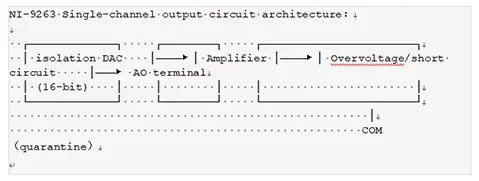
- Synchronous update
A four-channel DAC can update its output values simultaneously on the same clock edge, ensuring zero time skew between the multi-channel outputs. This is particularly critical in the following scenarios:
Multi-axis motion control: Speed/position commands for each axis need to be strictly synchronized
Multi-channel waveform generation: Precise phase relationships need to be maintained
Hardware-in-the-loop simulation: Multiple excitation signals must be time-aligned
- Software timing and hardware timing
The NI-9263 supports two timing modes:
Software timing: Outputs one sample point at a time, triggered by software. Suitable for low-rate or event-driven output scenarios. Each channel can run an independent software timing task.
Hardware timing: Uses a hardware sampling clock to continuously output at a set rate, up to 100 kS/s/ch. Only one hardware timing task can run on the same device at a time
Comparison of C-series analog output modules
| Model | Module type | Signal range | No.Channel | Sampling Rate | Synchronous | Resolution | Connection interface |
| NI-9260 | Voltage output | 3 Vrms | 2 | 51.2 kS/s/ch | Yes | 24 Bit | BNC,micro XLR |
| NI-9263 | Voltage output | ±10 V | 4 | 100 kS/s/ch | Yes | 16 Bit | Bolt/Spring Terminal |
| NI-9264 | Voltage output | ±10 V | 16 | 25 kS/s/ch | Yes | 16 Bit | 37 Pin D-SUB |
| NI-9265 | Voltage output | 0-20 mA | 4 | 100 kS/s/ch | Yes | 16 Bit | Bolt terminals |
| NI-9269 | Voltage output | ±10 V | 4 | 100 kS/s/ch | Yes | 16 Bit | Bolt terminals |
Hazardous Site Certification
| Certification bodies | Level |
| UL ( USA ) | Class I, Division 2, Groups A, B, C, D, T4; Class I, Zone 2, AEx nA IIC T4 Gc |
| C-UL ( Canada ) | Class I, Division 2, Groups A, B, C, D, T4; Ex nA IIC T4 Gc |
| ATEX/IECEx ( Euro / International ) | Ex nA IIC T4 Gc; DEMKO 07 ATEX 0626664X; IECEx UL 14.0089X |
Note:
For applications requiring higher current drive or inter-channel isolation, NI recommends considering the NI-9269 C-Series voltage output module. The NI-9269 also offers ±10 V, 4 channels, and 100 kS/s/ch output capability, but with added inter-channel isolation and greater current drive capability.
Tailored Solutions: OEM & ODM Customization
We understand that off-the-shelf products cannot always meet highly specialized project requirements. To bridge this gap, our veteran engineering team offers comprehensive OEM and ODM customization services. From modified frequency ranges and specialized triggering configurations to bespoke mechanical enclosure components, we collaborate directly with your team to engineer the ideal solution. Our highly adaptable design methodology ensures that your unique application demands are precisely met, all while upholding our uncompromising standards of manufacturing excellence.

Applications:
| NI-9263 Role in | Case | |
| Process control | Actuator drive signal in closed-loop control | The heating power is adjusted by outputting a 0-10 V signal in the ultra-high temperature and high pressure rheometer |
| Motion control | Motor speed/position command signal | Generating motor positioning speed setpoints in the champagne shaker experiment platform |
| Vibration excitation | Exciter drive signal | In the same case as above, a vibration excitation signal is generated |
| Waveform generation | Standard or custom waveform output | Analog output control in high-speed laser engraving |
| Hardware in the loop | Simulation excitation signal | Real-time signal simulation in conjunction with CompactRIO FPGA |
| Sensor simulation | Analog sensor output signal | Replacement of real sensors in calibration and verification system |


FAQs:
✅What are the output range and drive capability of the NI-9263? Can it be used to directly drive motors or relays?
A:
- Output Range: Its nominal output range is ±10 V.
- Drive Current: The maximum output current per channel is ±1 mA (when the load impedance is greater than 10 kΩ).
- Drive Limitations: It cannot directly drive motors, relays, solenoid valves, or high-power speakers. Its output current is extremely low (only in the 1 mA range), primarily used for transmitting weak control voltage signals. If driving high-power devices is required, an external power amplifier, signal isolation transmitter, or servo driver must be connected after its output.
✅What is the update rate of the NI-9263? Can it be used to create a high-speed arbitrary waveform generator (AO)?
A:
- Its maximum update rate is 100 kS/s/ch (100,000 updates per second per channel)
- Its four channels have independent digital-to-analog converters (DACs), supporting fully synchronous output
- Applications: A rate of 100 kS/s is more than sufficient for audio signal generation, low-frequency arbitrary waveforms (such as square waves, sine waves, and triangle waves around 1kHz), and most industrial control PID closed-loop regulation. However, its speed is clearly insufficient for high-frequency radio, radio frequency (RF), or microsecond-level radar pulse modulation.
✅When the output voltage of one channel is changed in the software, will other channels experience sudden changes or fluctuations?
A:
No. Because the NI-9263's four channels are truly independent DAC (digital-to-analog converter) architectures, not time-division multiplexed using a single DAC and multiplexed relays (MUX). This means that data updates in any one channel will not cause signal jitter, voltage drops, or hardware crosstalk in other channels.
✅Why is there a voltage of several millivolts or even tens of millivolts at the output of my NI-9263 as soon as the computer is powered on, even before any programs are running?
A:
This falls under the module's initial power-on state (Glitch).
From the moment the chassis powers on until the DAQmx driver fully takes over the module, the DAC chip undergoes a brief hardware initialization process, during which a small voltage glitch may occur.
Furthermore, even if the output is configured to 0V, residual voltage in the microvolt to millivolt range may exist due to the op-amp's hardware bias. If the external actuator is extremely sensitive (e.g., extremely slight valve opening), it is recommended to add a power-on hysteresis relay protection layer to the hardware circuitry, closing the control loop only after the program initialization is complete.
✅Why does the output waveform sometimes look like discontinuous "staircase steps" instead of a smooth curve?
A:
This is typically due to two main reasons:
Resolution limitations: The NI-9263 is a 16-bit DAC. Within a ±10V range (20V peak-to-peak), its minimum voltage resolution is approximately 20V/65536 ≈ 305μV. If you generate a very small signal amplitude (e.g., a sine wave of a few millivolts), the step effect will become noticeable.
Insufficient software update frequency: If the software provides too few data packets when writing waveform data, or if the DAQmx write update rate is not set to a high value (e.g., incorrectly set to 1kS/s instead of 100kS/s), the waveform will exhibit large steps on the time axis.

Contact Us
Ready to integrate reliable voltage module control into your system? Our team is here to help you select the right configuration and provide ongoing support.
Contact our technical specialists at manager03@mxtdinfo.com / manager02@mxtdinfo.com for detailed specifications, pricing information, or to discuss your custom requirements. We're committed to delivering the perfect NI-9263 C Series Voltage AO Module solution for your application needs.
Our customers’ satisfaction speaks for our quality — contact us to experience the same reliable service.
Our customers’ satisfaction speaks for our quality — contact us to experience the same reliable service.