- English
- French
- German
- Portuguese
- Spanish
- Russian
- Japanese
- Korean
- Arabic
- Greek
- German
- Turkish
- Italian
- Danish
- Romanian
- Indonesian
- Czech
- Afrikaans
- Swedish
- Polish
- Basque
- Catalan
- Esperanto
- Hindi
- Lao
- Albanian
- Amharic
- Armenian
- Azerbaijani
- Belarusian
- Bengali
- Bosnian
- Bulgarian
- Cebuano
- Chichewa
- Corsican
- Croatian
- Dutch
- Estonian
- Filipino
- Finnish
- Frisian
- Galician
- Georgian
- Gujarati
- Haitian
- Hausa
- Hawaiian
- Hebrew
- Hmong
- Hungarian
- Icelandic
- Igbo
- Javanese
- Kannada
- Kazakh
- Khmer
- Kurdish
- Kyrgyz
- Latin
- Latvian
- Lithuanian
- Luxembou..
- Macedonian
- Malagasy
- Malay
- Malayalam
- Maltese
- Maori
- Marathi
- Mongolian
- Burmese
- Nepali
- Norwegian
- Pashto
- Persian
- Punjabi
- Serbian
- Sesotho
- Sinhala
- Slovak
- Slovenian
- Somali
- Samoan
- Scots Gaelic
- Shona
- Sindhi
- Sundanese
- Swahili
- Tajik
- Tamil
- Telugu
- Thai
- Ukrainian
- Urdu
- Uzbek
- Vietnamese
- Welsh
- Xhosa
- Yiddish
- Yoruba
- Zulu
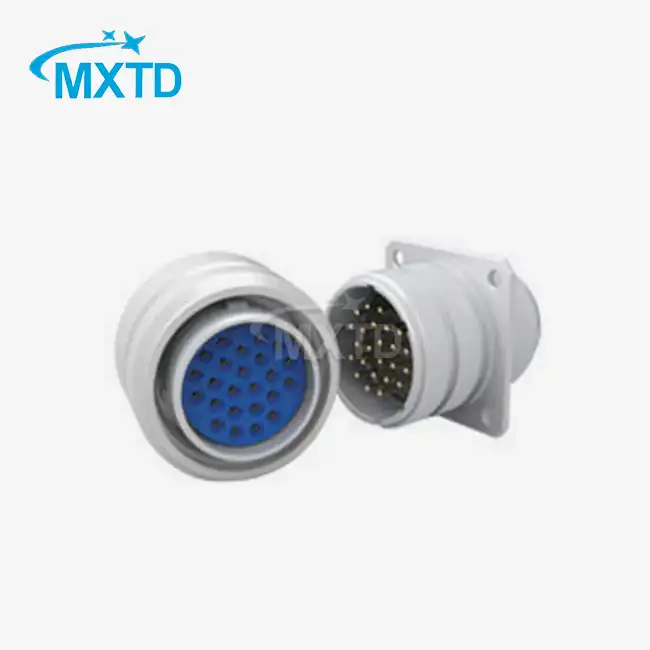
JF3-134ZK-02/TJ-02 Separation (Detachment) Electrical Connector
2.Flame Resistance: 850℃, 120s
3.Operating Air Pressure: 101.33kPa ~ 22Pa
4. Rain Protection (Mated Condition): 5mm/min
5.Salt Spray: 48h
6.Sinusoidal Vibration: 200 m/s²
7.Mechanical Life: 500 cycles
JF3-134ZK-02/TJ-02 Separation (Detachment) Electrical Connector
The JF3-134ZK-02/TJ-02 series of separation (disengagement) electrical connectors are specialized electrical connectors, mainly used in aerospace, aviation, missiles, rockets and other weapon systems as well as various ground equipment. When the equipment is operating normally, these connectors transmit electrical signals and power. When separation is required (such as inter-stage separation, shedding of the cover, load detachment, etc.), they can achieve instantaneous and reliable automatic disengagement or mechanical separation.
Product Descriptions from the Supplier
This product complies with the Q/21EJ2132 standard. It adopts two locking methods: handwheel locking and direct plug locking. It achieves reliable detachment through mechanical separation. The connection method is low-frequency contact component welding, and it is widely used in systems of aerospace, ships, aviation and other fields.
Specifications
[Environmental Performance]
- Operating Temperature: -55℃ ~ +125℃
- Flame Resistance: 850℃, 120s
- Operating Air Pressure: 101.33kPa ~ 22Pa
- Rain Protection (Mated Condition): 5mm/min
- Salt Spray: 48h
[Mechanical Performance]
- Random Vibration: 0.4 G²/Hz, overall RMS acceleration 26.4 G
- Sinusoidal Vibration: 200 m/s²
- Shock: 1200 m/s²
- Acceleration: 500 m/s²
- Mechanical Life: 500 cycles
- Mechanical Separation Force: 55.8 N ~ 150 N
- Separation Speed: < 3 m/s
[Electrical Performance]
Rated Current and Contact Resistance
| Contact Specification | Rated Current (A) | Contact Resistance (mΩ) | Number of Contacts |
|---|---|---|---|
| Ø3 | 40 | ≤2 | 4 |
Withstanding Voltage
| Operating Condition | Test Voltage (50Hz, AC RMS) V |
|---|---|
| Normal Temperature and Pressure | 1500 |
| Damp Heat | 500 |
| Low Air Pressure (22Pa) | 200 |
Insulation Resistance
| Operating Condition | Normal Temperature (MΩ) | High Temperature / Low Temperature (MΩ) | Damp Heat (MΩ) |
|---|---|---|---|
| Between Contacts and Between Contacts and Shell | ≥1000 | ≥500 | ≥20 |
Applications
-
Launch Vehicle Stage Separation — Reliable disconnection of electrical signals and power between rocket stages.
-
Payload Separation — Electrical disconnection between satellites, spacecraft, and launch vehicles during payload separation.
-
Fairing Jettison — Safe disconnection of electrical circuits during fairing separation.
-
Missile Stage Separation — Electrical disconnection control between stages of tactical missiles, air defense missiles, etc.
-
Missile Launcher Separation — Automatic electrical disconnection when the missile leaves the launcher.
-
UAV Payload Jettison — In-flight separation of external stores such as auxiliary fuel tanks and reconnaissance equipment.
-
Ground Launch Systems — Breakaway electrical interfaces between launchers and vehicles.
-
Special Vehicle Launch Systems — Electrical connection and disconnection for vehicle-mounted weapon systems during launch.
-
Wind Tunnel and Ground Test Equipment — Detachable electrical interfaces for testing scenarios requiring reliable separation.
-
Emergency Separation Systems — Reliable electrical disconnection under abnormal conditions to ensure system safety.
Key Features
-
Signal and Power Transmission — Reliably transmits electrical signals and power under normal operating conditions.
-
Automatic Separation — Instantly disconnects electrical connections automatically under predetermined conditions (such as launch, stage separation, fairing jettison).
-
Controlled Mechanical Separation Force — Maintains a stable separation force between 55.8N and 150N, ensuring reliable disconnection without impact damage.
-
Controlled Separation Speed — Separation speed less than 3m/s, preventing secondary damage caused by excessively rapid disconnection.
-
Extreme Temperature Adaptability — Maintains stable electrical and mechanical performance in temperatures ranging from -55°C to +125°C.
-
Low Air Pressure Operation — Functions normally under low air pressure conditions from 101.33kPa down to 22Pa.
-
Flame Resistance — Withstands flame exposure at 850°C for 120 seconds, suitable for high-temperature environments during launch or separation.
-
Environmental Protection — Provides rain protection (5mm/min in mated condition) and 48-hour salt spray resistance, suitable for harsh outdoor or marine environments.
-
Vibration and Shock Resistance — Withstands strong random vibration, sinusoidal vibration (200 m/s²), and shock (1200 m/s²), suitable for high-overload applications.
-
Insulation and Dielectric Strength Assurance — Ensures high insulation resistance and dielectric withstanding voltage, preventing electrical faults.
Custom Design
-
Structure & Locking — Handwheel / Push-pull locking, mechanical separation, separation force 55.8N ~ 150N
-
Electrical Performance — Ø3 × 4 contacts, 40A, contact resistance ≤2mΩ, insulation resistance ≥1000MΩ, dielectric withstanding voltage 1500V
-
Environmental Adaptability — Operating temperature -55℃ ~ +125℃, flame resistance 850℃/120s, low air pressure 101.33kPa ~ 22Pa, rain protection, salt spray 48h, vibration and shock resistance
-
Mechanical Life — 500 cycles
-
Applications — Aerospace, aviation, marine systems

Why Choose MXTD
Authorized HL Distributor: 100% genuine JF3-134ZK-02/TJ-02 Separation (Detachment) Electrical Connector, Compliant with standard: Q/21EJ1302
Military Application Expertise: Our engineering team specializes in defense and aerospace interconnection solutions, providing precise product matching.
Rigorous Qualification Testing: Every batch undergoes vibration, sealing, and electrical performance testing to ensure reliability.
Customization Speed: Rapid response to custom design requests for tight-deadline military and telecommunication projects.
Global Logistics Network: Efficient delivery to defense contractors, telecommunication providers, and aerospace manufacturers worldwide.
Lifetime Technical Support: 24/7 assistance for installation, maintenance, and troubleshooting of critical communication systems.

FAQ
Q: How reliable is the separation?
A:Mechanical separation with separation force of 55.8N ~ 150N and separation speed <3m/s, ensuring smooth and reliable disconnection.
Q: Can it withstand extreme environments?
A: Yes. Operating temperature -55℃ ~ +125℃, flame resistance 850℃/120s, low air pressure 101.33kPa ~ 22Pa, rain protection, and salt spray 48h.
Q: What is its vibration and shock resistance?
A:Random vibration 0.4G²/Hz (26.4G RMS), sinusoidal vibration 200m/s², shock 1200m/s², suitable for high-overload conditions.
Q: Is the electrical performance stable?
A: Yes. Contact resistance ≤2mΩ, insulation resistance ≥1000MΩ, dielectric withstanding voltage 1500V, ensuring reliable electrical performance.
Q:What is the service life?
A: Mechanical life of 500 cycles.

Contact Us
This product features a mechanical separation structure with a separation force of 55.8N to 150N and a separation speed of less than 3m/s, ensuring reliable and smooth disconnection. It operates within a temperature range of -55℃ to +125℃, withstands flame exposure at 850℃ for 120 seconds, and adapts to harsh conditions including low air pressure, rain protection, and 48-hour salt spray. With excellent vibration and shock resistance, stable electrical performance, and a mechanical life of 500 cycles, it complies with the Q/21EJ2132 standard and is suitable for high-reliability systems in aerospace, aviation, and marine applications.
Email: manager03@mxtdinfo.com
Our customers’ satisfaction speaks for our quality — contact us to experience the same reliable service.